Religion in Mauritius: Hindu, Christian & Muslim Population
Hinduism is the largest religion in Mauritius, but it is not an absolute majority religion. According to the latest detailed figures from the 2022 Population Census, around 47.9% of residents of the Republic of Mauritius are Hindu, 32.3% are Christian and 18.2% are Muslim. Smaller groups include Buddhist and Chinese religious traditions, while less than 1% of residents reported having no religion.
Those numbers explain a lot about everyday Mauritius. Hindu temples, Catholic churches and mosques are found across the island, religious festivals become national public holidays, and it is perfectly normal for different faith communities to live within the same town or village.
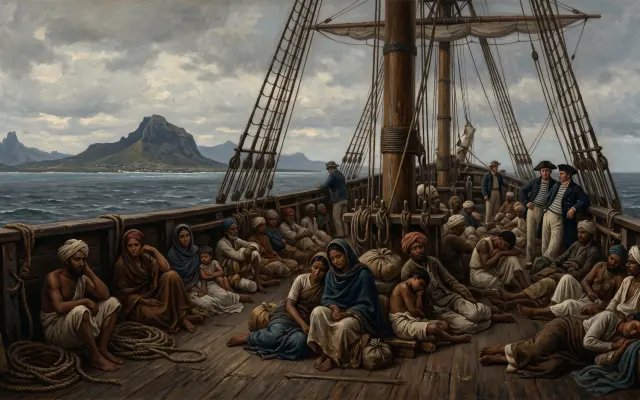
Religion in Mauritius is also closely connected with the island’s history. French colonial rule strengthened Catholicism, Indian migration during and after the indentured-labour period transformed the religious landscape through Hinduism and Islam, and Chinese migration brought its own religious and cultural traditions. Over generations, these communities became part of a distinctly Mauritian society rather than simply reproducing the cultures of the countries their ancestors came from.
This guide looks at the actual numbers, the main religions practised in Mauritius, the festivals you will see throughout the year and the religious places visitors are most likely to encounter.
Religion in Mauritius: The Numbers
The most useful source is the 2022 Population Census from Statistics Mauritius. Rather than relying on estimates repeated across travel websites, it records the religion reported by residents themselves.
| Religion | Residents | Share of Population |
|---|---|---|
| Hindu | 590,263 | 47.9% |
| Christian | 398,212 | 32.3% |
| Muslim | 224,885 | 18.2% |
| Buddhist / Chinese | 5,053 | 0.4% |
| No religion | 7,753 | 0.6% |
| Other / not stated | 6,931 | 0.6% |
Source: Statistics Mauritius, 2022 Population Census. Percentages above combine the detailed religious categories used in the census and are rounded.
There is one useful distinction to understand. These figures refer to the Republic of Mauritius, which includes Rodrigues and the smaller outer islands as well as the main island.
If you look only at the island of Mauritius, the proportions shift slightly: Hindus account for approximately 49.6% of the resident population, Christians around 29.9% and Muslims approximately 18.9%. One reason for the difference is Rodrigues, whose population is overwhelmingly Christian, particularly Roman Catholic.
Within Christianity, Roman Catholicism is by far the largest denomination. The 2022 census counted more than 307,000 Roman Catholics across the Republic, alongside other Christian denominations including Pentecostal, Anglican, Presbyterian, Seventh-day Adventist and other churches.
Hinduism is similarly diverse. The census separately records communities including Tamil Hindu, Telugu Hindu, Marathi Hindu, Vedic or Arya traditions and other Hindu groups. So while it is useful to say that almost 48% of the country is Hindu, that single percentage contains several different religious and cultural traditions.
If you want a deeper look specifically at Hindu life on the island, read our guide to Hinduism in Mauritius.
Hinduism, Christianity and Islam in Mauritius
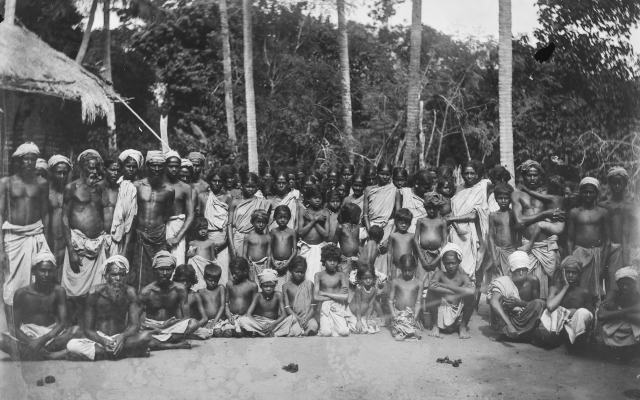
Hinduism is the largest faith in Mauritius, largely reflecting the migration of Indian labourers to the island during the nineteenth century. After slavery was abolished in the British Empire, Mauritius became an important centre of the indentured-labour system. Hundreds of thousands of migrants from India arrived during that period, bringing languages, food traditions and religious practices that became central to modern Mauritian life.
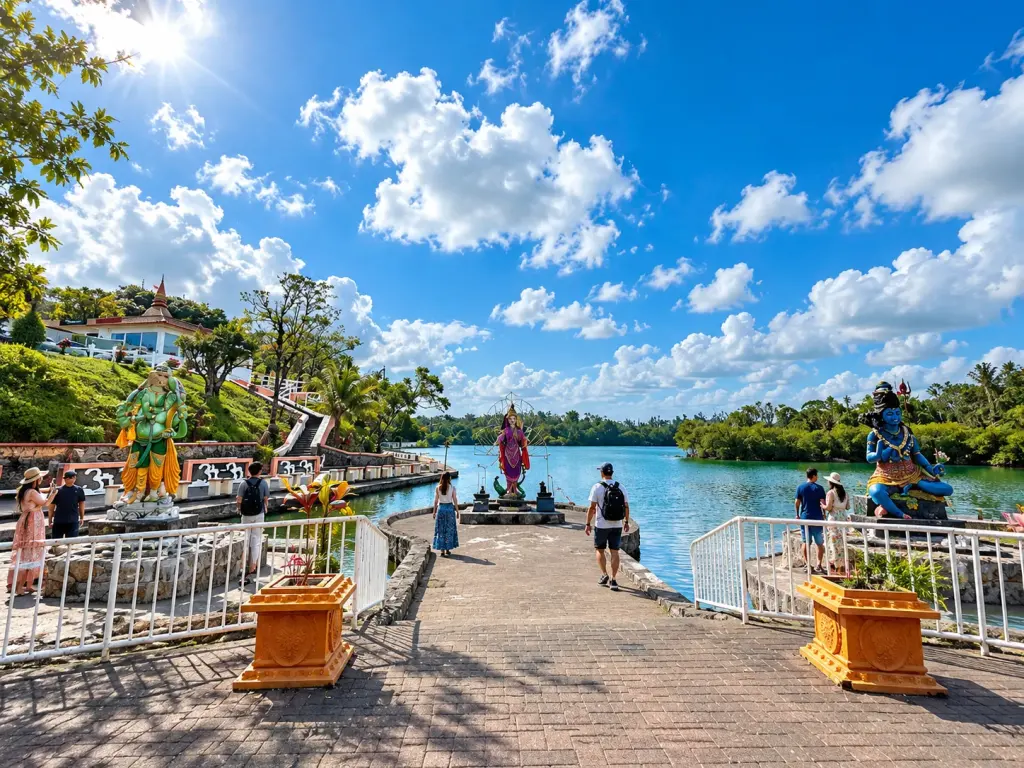
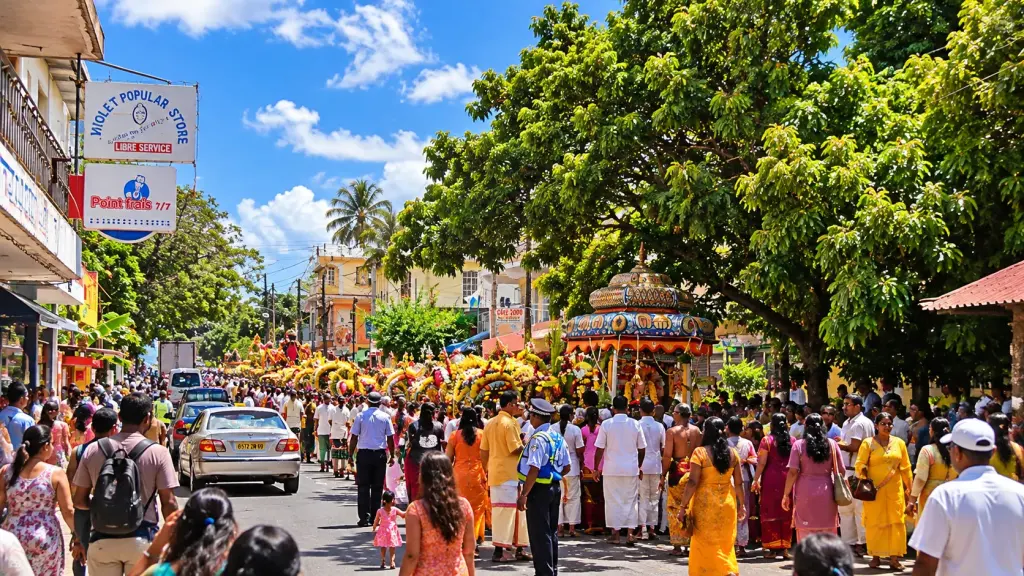
One of the clearest examples is Ganga Talao, or Grand Bassin, a crater lake in the southern highlands that has become Mauritius’ most important Hindu pilgrimage site. During Maha Shivaratree, devotees from towns and villages across the island travel towards the lake, many walking while carrying decorated kanwars. Government agencies make special traffic, health, infrastructure and security arrangements because the pilgrimage affects much of the country rather than only the religious site itself.
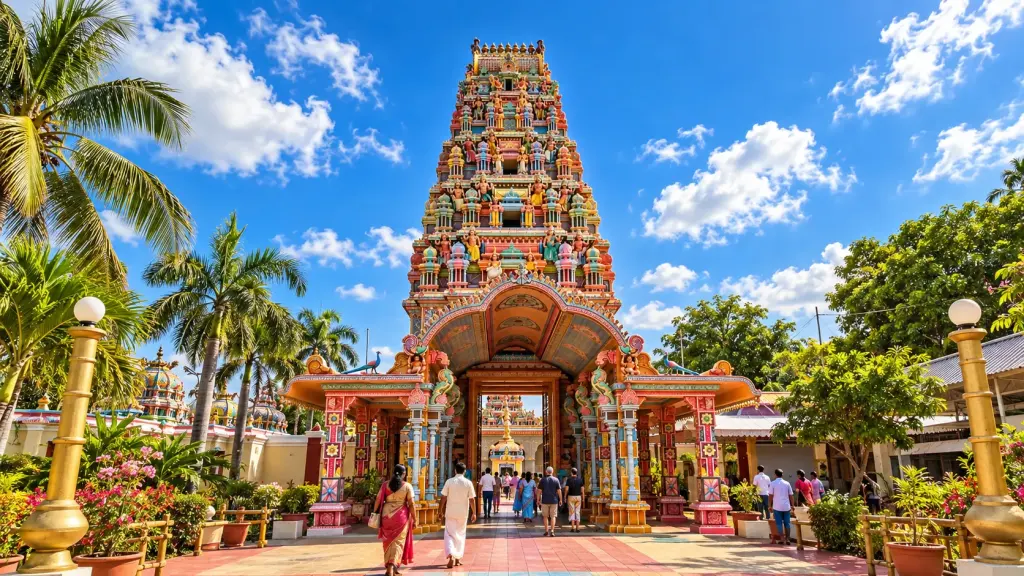
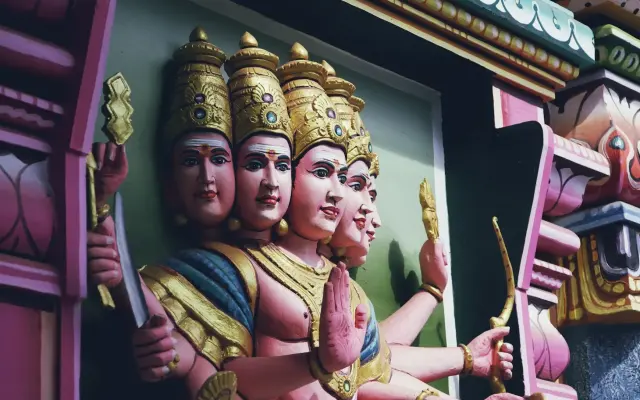
Another important temple is Maheswarnath Mandir in Triolet. Dedicated principally to Lord Shiva, it was founded in 1888 and is regarded as one of the island’s oldest and largest Hindu temples. It is relatively easy to visit if you are staying around Grand Baie or elsewhere in the north.
Mauritian Hinduism should not be treated as one completely uniform tradition. Sanatanist and Arya Samaj traditions coexist with strong Tamil, Telugu and Marathi identities. This diversity becomes particularly visible through festivals. Maha Shivaratree, Divali, Ganesh Chaturthi, Ugaadi and Thaipoosam Cavadee are all part of the national calendar, but they are associated with different traditions and communities.
The importance of religion also extends into family life. Our guide to a Hindu Mauritian wedding explains traditions such as Geet Gawai, Tilak, Saffran, the Shaadi and Chawtari, all of which show how religion and family customs have developed in a distinctly Mauritian way.
Christianity is the second-largest religious grouping in Mauritius. Roman Catholicism is dominant within it and has deep roots in the French colonial period. The British took control of Mauritius in 1810 but allowed many French institutions, customs and laws to continue, and Catholicism remained an important part of Mauritian society.
Christianity today cuts across several communities. Catholic churches can be found throughout the island, from small coastal villages to major towns, while Protestant, Pentecostal, Anglican, Presbyterian and other Christian congregations also have established communities.
One of the best-known religious figures in Mauritian Catholicism is Father Jacques-Désiré Laval. Every September, large numbers of people travel to his shrine at Sainte-Croix near Port Louis. What is especially interesting is that visitors are not exclusively Catholic; the pilgrimage has also attracted Mauritians from other religious backgrounds.
Christian festivals are part of the national calendar too. Christmas is a public holiday, as is the Assumption of the Blessed Virgin Mary. Christmas in Mauritius is both religious and cultural: churches hold services while many families, including some who are not particularly religious, celebrate with meals, gifts and gatherings during the warm Mauritian summer.
Islam is the country’s third-largest faith, accounting for just over 18% of the resident population in the latest census. Muslim communities have long been part of Mauritius’ commercial and cultural life, with many families tracing ancestry to India, particularly Gujarat and other regions of the subcontinent.
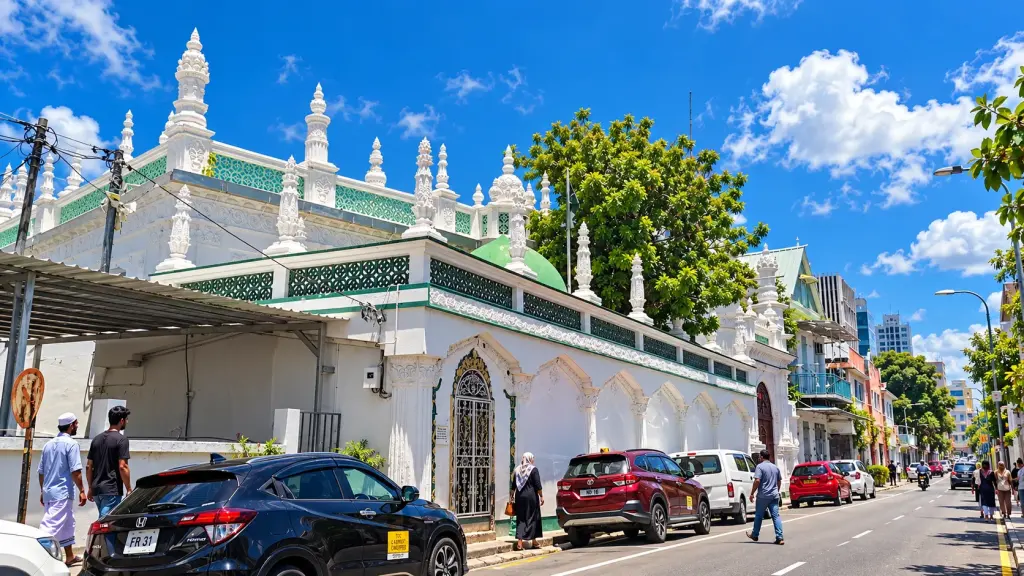
The most prominent Islamic landmark for visitors is the Jummah Masjid in Port Louis. The mosque dates from the nineteenth century and sits in the middle of the capital’s busy commercial district. Its architecture combines Indian, Islamic and Creole influences, and its location near Chinatown and the Central Market perfectly illustrates how closely different strands of Mauritian history sit beside one another.
During Ramadan, Muslims fast from dawn to sunset, while Eid-ul-Fitr marking the end of Ramadan is a public holiday in Mauritius. As in other parts of the world, its exact date depends on the lunar calendar and the observation of the moon.
What About Buddhism and Chinese Religion?
The Chinese community represents a much smaller share of the population than the Hindu, Christian or Muslim communities, but its religious heritage is still highly visible, particularly in Port Louis.
It is worth being careful with the label “Buddhist”. Traditional Chinese religious practice in Mauritius can incorporate elements associated with Buddhism, Taoism, ancestor veneration and Chinese folk religion, while many Sino-Mauritians are also Christian. The Statistics Mauritius summary therefore uses a combined “Buddhist/Chinese” category rather than implying that every person of Chinese heritage follows Buddhism.
The most important site for visitors is Kwan Tee Pagoda at Les Salines in Port Louis. Built in 1842, it is recognised by Mauritius’ official tourism organisation as the oldest pagoda in the Southern Hemisphere and on the African continent. The temple is associated with Kwan Tee, traditionally revered in connection with loyalty, justice and protection.
The Chinese Spring Festival is also an official public holiday. Port Louis’ Chinatown becomes one of the most visible centres of the celebration, but Chinese-Mauritian food, family traditions and businesses are part of life throughout the year rather than appearing only during a festival.
The 2022 census also records much smaller Baháʼí, Jewish, Sikh and other religious communities. Mauritius is therefore more religiously varied than the three large percentages at the top of this article suggest.
Religion Is Visible in Mauritius’ Public Calendar
Perhaps the easiest way to understand the place religion occupies in Mauritius is simply to look at the list of public holidays.
In 2026, the official calendar includes Thaipoosam Cavadee, Maha Shivaratree, the Chinese Spring Festival, Ugaadi, Eid-ul-Fitr, the Assumption of the Blessed Virgin Mary, Ganesh Chaturthi, Divali and Christmas. These sit alongside secular holidays such as Independence and Republic Day, Labour Day, the Abolition of Slavery and the Arrival of Indentured Labourers.
That does not mean every Mauritian personally celebrates every religious holiday. It does mean that the country’s public calendar formally reflects the major communities that helped shape it.
The traditions are also not always isolated within one community. Neighbours may exchange Divali cakes, families may send food to one another during Eid, Christmas decorations appear across shopping centres and homes, and major pilgrimages affect roads and businesses regardless of the religion of the people using them.
This is a better way of understanding religious coexistence in Mauritius than simply describing the country as perfectly harmonious. Mauritius has political and social disagreements like any other country, and religious identity can overlap with ethnicity and politics. What is distinctive is that several large religious communities have been living alongside one another for generations and are embedded in the country’s institutions, calendar and everyday culture.
The Constitution provides an important legal foundation. Section 11 protects freedom of thought and religion, including the freedom to change religion and to practise or manifest a religion individually or with others, publicly or privately.
For a broader introduction to how religion fits alongside language, food, ancestry and everyday social customs, see our guide to Mauritian culture.
Visiting Religious Sites in Mauritius
Religious sites in Mauritius are generally welcoming to respectful visitors, and they are worth including in a trip even if you are not religious yourself. They often explain aspects of the island that beaches and resorts cannot.
At Hindu temples, remove your shoes where requested and dress reasonably modestly. At Ganga Talao, remember that this is an active pilgrimage and worship site rather than simply a tourist attraction. Avoid interrupting people who are praying or positioning yourself in front of ceremonies simply to take photographs.
When visiting a mosque, dress modestly and follow instructions concerning shoes and areas open to visitors. Avoid entering during congregational prayer unless visitors are specifically welcome at that time.
The same principle applies in churches and Chinese temples: these are functioning religious spaces first and attractions second. Photography may be fine in one area and inappropriate in another, so ask when uncertain.
If you want to experience religious culture rather than simply see religious buildings, festivals can be more memorable. Maha Shivaratree is one of the largest, with pilgrims travelling towards Ganga Talao. Thaipoosam Cavadee is particularly associated with the Tamil Hindu community, while Divali lights homes across the island. The Chinese Spring Festival is especially visible around Chinatown, and the Père Laval pilgrimage brings large numbers of people to Sainte-Croix each September.
You do not need to belong to the religion to observe these events respectfully. In fact, one of the interesting things about Mauritius is how frequently cultural participation extends beyond a person’s own faith.
If you are planning a first trip and want to combine these cultural sites with beaches and nature, our Ultimate Guide to Mauritius gives a practical overview of how to explore the island.
So, What Is the Main Religion in Mauritius?
Hinduism is the largest religion in Mauritius. The latest 2022 census puts Hindus at approximately 47.9% of the population of the Republic of Mauritius, followed by Christians at around 32.3% and Muslims at approximately 18.2%.
However, saying “Mauritius is a Hindu country” would give an incomplete picture. There is no single religion followed by more than half of the population across the Republic, and Christianity and Islam both have large, long-established communities. Religious identity also varies by place: Rodrigues is overwhelmingly Christian, parts of Port Louis have substantial Muslim and Catholic populations, while many rural districts of the main island have larger Hindu populations.
The result is that religion in Mauritius is less something visitors encounter in one special cultural district and more something woven throughout daily life. You see it in roadside temples, village churches, the Jummah Masjid in central Port Louis, processions heading towards Ganga Talao, Divali lights outside family homes and the national calendar itself.
For visitors, understanding that religious mix makes the rest of Mauritius easier to understand too. Its food, languages, weddings, festivals and family traditions all make more sense once you see how several communities arrived on the island and gradually built a shared Mauritian identity while maintaining distinct beliefs of their own.
Official Sources
- Statistics Mauritius – 2022 Population Census, Demography Report
- Constitution of the Republic of Mauritius – Freedom of Conscience and Religion
- Prime Minister’s Office – Public Holidays 2026
Religious percentages in this article are calculated from the detailed categories in the official 2022 Population Census and rounded to one decimal place.
Tours and activities in Mauritius
Hand-picked from GetYourGuide. Free cancellation on most bookings.
Some links on this page are affiliate links. If you book through them we may earn a small commission, at no extra cost to you. It helps keep Creole Mauritius free.
Questions and tips