Mauritius Flag Meaning: What the Four Colours Represent
Some links on this page are affiliate links. If you book through them we may earn a small commission, at no extra cost to you. It helps keep Creole Mauritius free.
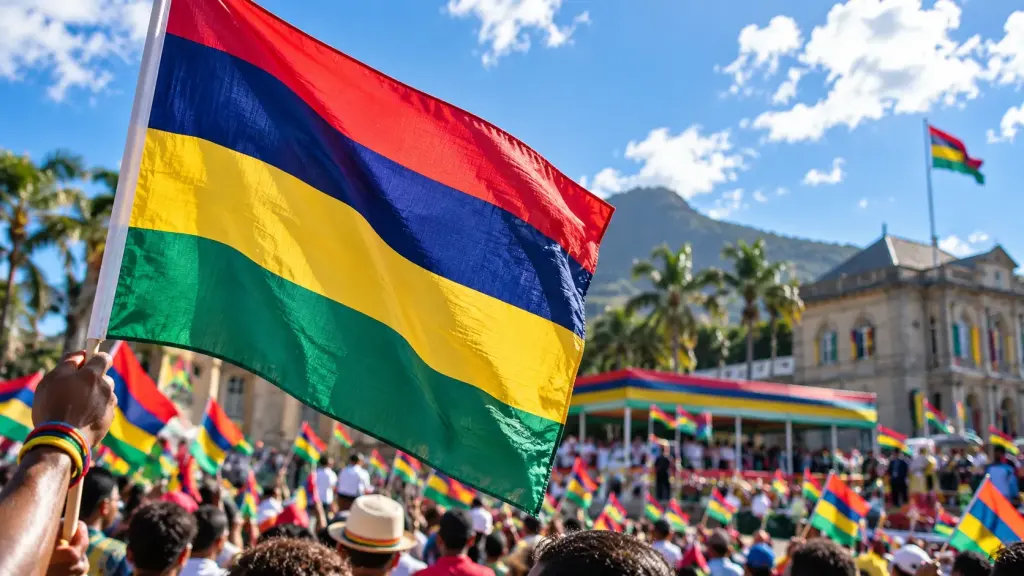
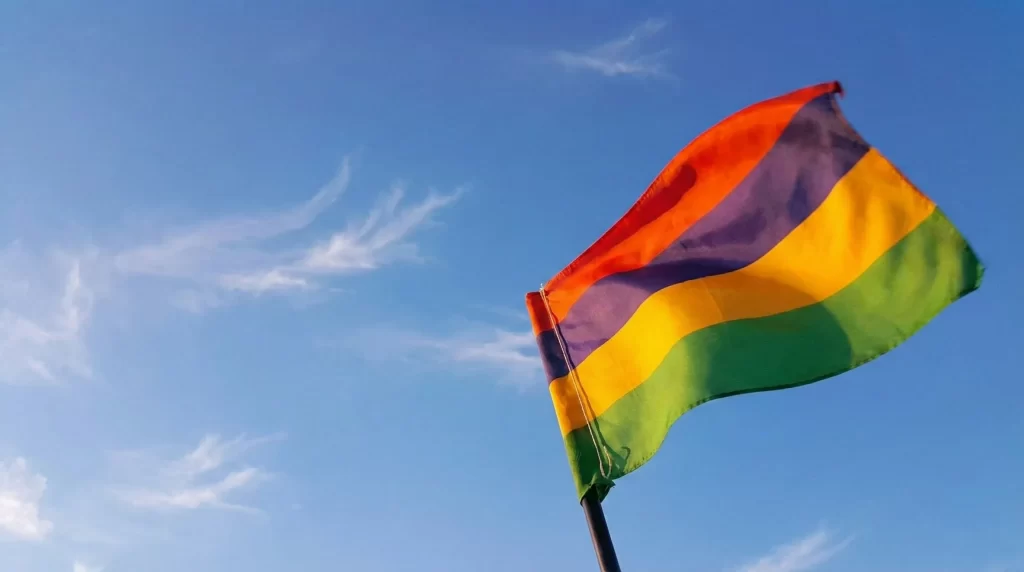
The Mauritius flag has four equal horizontal bands: red, blue, yellow and green. Officially, red represents the struggle for freedom and independence, blue represents the Indian Ocean, yellow represents the new light of independence, and green represents the agriculture of Mauritius and the island’s greenery throughout the year.
Known locally as Les Quatre Bandes, or “The Four Bands”, the flag was adopted on 12 March 1968, the day Mauritius became independent from Britain. Its simple design has remained unchanged ever since.
There is also a second, political interpretation of the four colours linked to the major political parties of the independence era. That reading is part of Mauritian historical discussion, but it should be kept separate from the official meaning defined by law.
| Colour | Official Meaning |
|---|---|
| Red | The struggle for freedom and independence |
| Blue | The Indian Ocean surrounding Mauritius |
| Yellow | The new light of independence |
| Green | The agriculture of Mauritius and the island’s greenery throughout the year |
How the Mauritius Flag Was Created
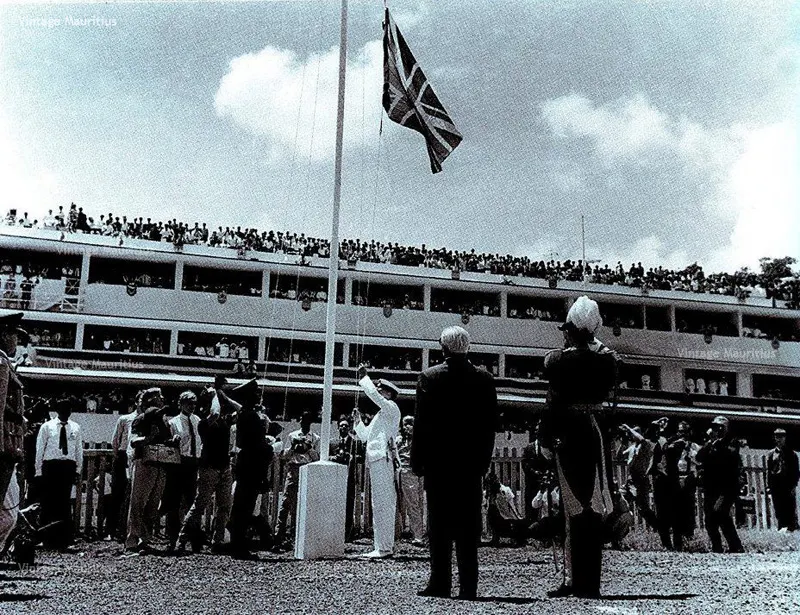
The modern flag appeared at one of the most important moments in Mauritian history. After years of constitutional negotiations and a closely contested political debate about the island’s future, Mauritius became independent on 12 March 1968.
At noon that day at the Champ de Mars in Port Louis, the British Union Jack was lowered and the new four-colour Mauritius flag was raised in its place.
The location remains closely associated with the country’s National Day celebrations. Mauritius celebrates both Independence Day and Republic Day on 12 March, because the country became independent in 1968 and later became a republic on the same date in 1992. You can read more about the events leading up to independence in our guide to Mauritius Independence Day and its history.
The flag itself was created by Gurudutt Moher, a Mauritian schoolteacher. His contribution was not widely known for many years, but Mauritian parliamentary records now formally recognise him as the creator of the national flag.
The design was recorded at the College of Arms in London shortly before independence and then became the new country’s national symbol when the flag was raised on 12 March 1968.
What Each Colour of the Mauritius Flag Means
The meaning of the colours is now specifically set out in Mauritian law under the National Flag, Arms of Mauritius, National Anthem and Other National Symbols of Mauritius Act 2022.
Red: Freedom and Independence
Red represents the struggle for freedom and independence.
This is deliberately broad. Mauritius’ path towards independence involved political campaigns for greater democratic representation, constitutional reform and eventual self-government after centuries of Dutch, French and British colonial rule.
It also makes the colour meaningful beyond one community or political movement. Modern Mauritius was built by people with African, Malagasy, Indian, European, Chinese and mixed ancestry, each with a different historical relationship to the island. Our guide to who the Mauritians are explains how these different migrations shaped the population.
Blue: The Indian Ocean
Blue represents the Indian Ocean in which Mauritius is situated.
Mauritius is a small island state surrounded by the Indian Ocean, so the symbolism is perhaps the most immediately obvious of the four.
The ocean has always shaped life here, from early navigation and colonial trade to fishing, tourism and the island’s modern connections with Africa and Asia.
Yellow: The New Light of Independence
Yellow represents the new light of independence.
The colour reflects the optimism surrounding the creation of a new sovereign state in 1968. Independence meant Mauritius would have its own elected government, national symbols and greater control over its political future.
It is sometimes loosely described online as representing the sun, but the wording used in Mauritian law is more specific: the new light of independence.
Green: Agriculture and the Land
Green represents the agriculture of Mauritius and its colour throughout the twelve months of the year.
This made particular sense when the flag was adopted. Agriculture, especially sugar cane, dominated much of the Mauritian economy and landscape.
Sugar also played a major role in the history of slavery, indentured labour, land ownership and the development of towns and villages across Mauritius. You can explore that story in our article on how sugar shaped Mauritius.
What About the Political Meaning of the Four Colours?
There is another interpretation of Les Quatre Bandes that you will often hear in Mauritius. Historical accounts associate the four colours with four important political parties of the pre-independence period:
| Colour | Historical Political Association |
|---|---|
| Red | Labour Party |
| Blue | Parti Mauricien Social Démocrate (PMSD) |
| Yellow | Independent Forward Bloc (IFB) |
| Green | Comité d’Action Musulman (CAM) |
This interpretation is worth knowing, but it should not be confused with the official symbolism in Mauritian law.
The political situation at the time was also more divided than the idea of four parties coming together for independence might suggest. The Labour Party, IFB and CAM supported independence and later formed the Independence Party alliance. The PMSD, by contrast, argued for continued association with Britain rather than immediate independence.
So it is more accurate to say that the colours can also be read as reflecting the major political forces present around the creation of modern Mauritius, rather than saying that all four parties jointly led the independence movement.
The fact that all four colours ultimately appeared together on one national flag nevertheless made the design capable of representing a country emerging from a politically and communally divided period.
The Official Design of the Mauritius Flag
The design looks extremely simple, but the legal specification is precise. The flag must contain four horizontal stripes of equal width, arranged from top to bottom in this order:
- Red
- Blue
- Yellow
- Green
The official proportion is 3 horizontally to 2 vertically, usually written as a 3:2 ratio. The 2022 legislation also specifies official Pantone colour codes:
| Colour | Official Pantone Code |
|---|---|
| Red | 18-1664 TCX |
| Blue | 19-3939 TCX |
| Yellow | 14-0957 TCX |
| Green | 17-6030 TCX |
The same law also regulates the dimensions and use of official flags. A standard mast flag, for example, is specified at 1,800 mm by 1,200 mm. This is one area where I would avoid relying on colours copied from random flag graphics online, because some digital reproductions use noticeably different shades from the legal standard.
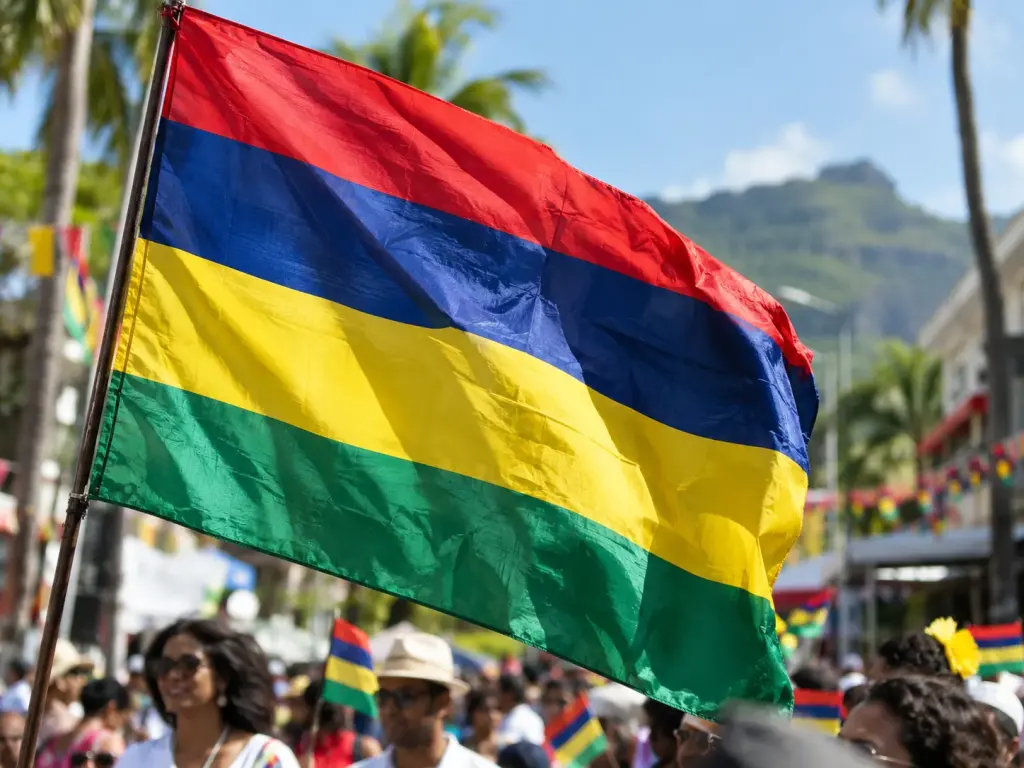
IMAGE PLACEHOLDER
Suggested image: Close-up photograph of the four bands of the Mauritius flag during Independence Day celebrations.
Caption: The order of the colours is fixed by law: red, blue, yellow and green from top to bottom.
Why the Flag Still Matters in Mauritius
The flag becomes particularly visible every March in the weeks leading up to National Day. You will see the four colours outside schools, government buildings, shops and homes, as well as on cars and clothing.
At official National Day celebrations, the raising of the flag remains one of the central ceremonies, usually accompanied by the national anthem, Motherland.
For many Mauritians, Les Quatre Bandes has gradually become something simpler than all of the political and historical stories behind it. It is the most immediately recognisable visual symbol of the country.
That is perhaps why the design has lasted unchanged since independence. Four simple stripes are broad enough to represent a country whose population does not come from one single ethnic, religious or linguistic background.
Understanding the flag therefore also means understanding something about Mauritius itself. The country’s national identity developed out of several communities with very different histories, but the flag places all four colours beside one another at exactly the same width.
For more on the people, traditions and history behind modern Mauritius, continue with our guide to Mauritian culture and Ultimate Guide to Mauritius.
Official Sources
Tours and activities in Mauritius
Hand-picked from GetYourGuide. Free cancellation on most bookings.
Questions and tips