
Guide to Mahebourg Market Mauritius (Updated)

Of all the sensory experiences available in Mauritius, and let’s be honest, there are enough to overload a small computer or a very sensitive golden retriever, few rival the vibrant, chaotic, and utterly authentic atmosphere of the Mahebourg Market Mauritus.
While Port Louis has the fame (and the traffic jams that make you question your life choices), Mahebourg has the heart. It is consistently ranked among the best local markets in Mauritius, offering a more authentic and less tourist-driven experience than many larger markets on the island.

This comprehensive guide to Mahebourg Market Mauritius covers every detail you need to know—from navigating the labyrinth of street food stalls to understanding the specific unwritten rules of the local bus routes, ensuring your visit is smooth, enjoyable, and doesn’t end with you accidentally buying a live goat or a knock-off tracksuit that dissolves in the rain.
Contents
1. Introduction: The Heart of the South
Mahebourg (pronounced May-bourg, not May-Hee-Berg, unless you want locals to look at you with deep confusion) is not just another town; it is the cradle of Mauritian history. Before Port Louis became the capital and stole all the glory, the Dutch and later the French established their primary settlements here. The town is named after Bertrand-François Mahé de La Bourdonnais, the French governor who probably had a very nice wig and a stern expression.
The market itself sits right near the waterfront, a symbolic location where the turquoise blue lagoon meets the hustle of commerce. Unlike the tourist-heavy arcades of the north (Grand Baie, we are looking at you) where prices are “flexible” (read: astronomically expensive for anyone with a sunburn), Mahebourg Market remains fiercely local. It is where grandmothers haggle with terrifying precision for the price of pomme d’amour (local tomatoes), where fishermen sell their morning catch with cigarettes dangling from their lips, and where the air is thick with the scent of fried chilies and salt water.
While there is a smaller daily market that serves the immediate needs of the town, the Monday Market is the main event. It is the Super Bowl of vegetable shopping. Once a week, the sleepy waterfront transforms into a sprawling open-air bazaar that stretches for kilometers. It’s basically the Mauritian version of Black Friday, but with better food, fewer flat-screen TVs, and significantly less actual violence, although the competition for the best gato pima can get intense.
2. Practical Information
Location
The market is situated on Rue de la Passe, right next to the Mahebourg Waterfront (Esplanade). It essentially takes over the entire street, forcing traffic to accept defeat and go elsewhere.
- Landmarks: Look for the Mahebourg Bus Terminal; the chaos starts just a few hundred meters from there. It is also near the struggle monument “Bataille de la Passe,” which commemorates a historic naval battle, though on Mondays the real battle is finding a parking spot.
Opening Hours & Days
The Main Event (Monday Market):
- Day: Every Monday. Mark it in your calendar. Tattoo it on your arm.
- Hours: Roughly 7:00 AM to 4:00 PM.
- Peak Time: 10:00 AM to 12:00 PM is when humanity descends. This is when the tour buses arrive, unloading passengers who look simultaneously amazed and terrified.
- Note: If Monday is a public holiday, the big market is often held on Tuesday instead. Pa trakase (don’t worry), just check local schedules or ask your hotel receptionist, who will likely know the market schedule better than their own birthday.
Daily Market (Tuesday – Sunday):
- Hours: 8:00 AM to 4:00 PM (closes earlier on Sundays, usually by noon because everyone goes to the beach).
- Scope: Much smaller. It’s primarily a covered hall for fruits, vegetables, and meat. The sprawling textile stalls that take over the streets are largely absent, so don’t expect to buy your entire summer wardrobe on a Wednesday. You will, however, find excellent beef and fish if you are cooking for yourself.
Best Time to Visit
For the Monday Market, the “Golden Hour” is between 8:00 AM and 9:30 AM.
- Why early? The morning air is cooler, essential if you know the best time to visit Mauritius for weather, the produce is freshest, and you won’t get stuck behind a wall of tourists trying to take selfies with a pineapple. You will see locals doing their weekly shopping, which is a cultural experience in itself.
- Late afternoon: If you arrive after 2:30 PM, vendors are hot, tired, and packing up. You might get better deals as they try to offload stock, but the gato pima will be cold, and honestly, a cold chilli cake is a tragedy.
3. How to Reach Mahebourg Market
Mahebourg is well-connected as it is the transport hub for the southeast. Getting there is half the adventure.
By Bus
Traveling by bus is the most authentic, budget-friendly, and exhilarating way to reach the market. While not as modern as the Mauritius Metro, buses in Mauritius are colorful, loud, and cheaper than a stick of gum. They are often referred to as “Blue Torpedoes” for their speed and aggressive overtaking maneuvers.
- From Port Louis (North/West): Take Bus 198 from Victoria Square. It takes about 1 hour 25 minutes. Mari bon (very good) scenery if you sit on the left side, where you can see the mountain ranges and sugar cane fields.
- From Curepipe: Take Bus 9 from Jan Palach South. It’s a winding journey through the tea plantations.
- From Grand Baie: There is no direct bus. You have to go to Port Louis first and switch. Honestly, unless you are a die-hard public transport enthusiast or writing a book on bus terminals, just rent a car or take a taxi. It’s a long haul.
- The Experience: Expect Sega music blasting at a volume that vibrates your teeth. Expect the bus to stop every 40 meters. Expect to make new friends because you will be squeezed next to them.
By Car (Rental)
- Route: Take the M1 motorway southbound towards the airport. Mahebourg is clearly signposted. It’s a lovely drive until you hit the town center.
- Parking: Tansion! (Attention!) On Mondays, do not try to park right next to the market. The streets are gridlocked with pedestrians, vendors, stray dogs, and bicycles. You will get stuck, and you will cry. If you are new to driving here, check our guide on buying and registering a car in Mauritius for some local road tips.
- Where to Park: Look for parking near the Cavendish Bridge (Ville Noire side) and walk across the river. It’s a scenic 10-minute walk. Alternatively, try the residential streets near the Naval Museum.
- Cost: Street parking is generally free, but official “parking attendants” (guys in reflective vests who may or may not be official) may ask for a small fee (20–50 MUR) to watch your car. Pay it. It’s cheap insurance for your side mirrors.
By Taxi
Taxis will drop you right at the entrance, usually near the bus station. Fares vary wildly depending on your negotiation skills and how desperate you look. If you need help understanding the currency and what things should cost, check our guide on the cost of living in Mauritius 2025.
- Tip: Agree on a price before you get in. If the driver says “don’t worry, friend,” start worrying.
4. What to Expect: The Atmosphere
Unlike the Central Market in Port Louis, which is one of the island’s most famous trading hubs, Mahebourg feels more communal and relaxed. If you’re deciding which market to visit during your trip, our guide to the best local markets in Mauritius breaks down how each one compares.
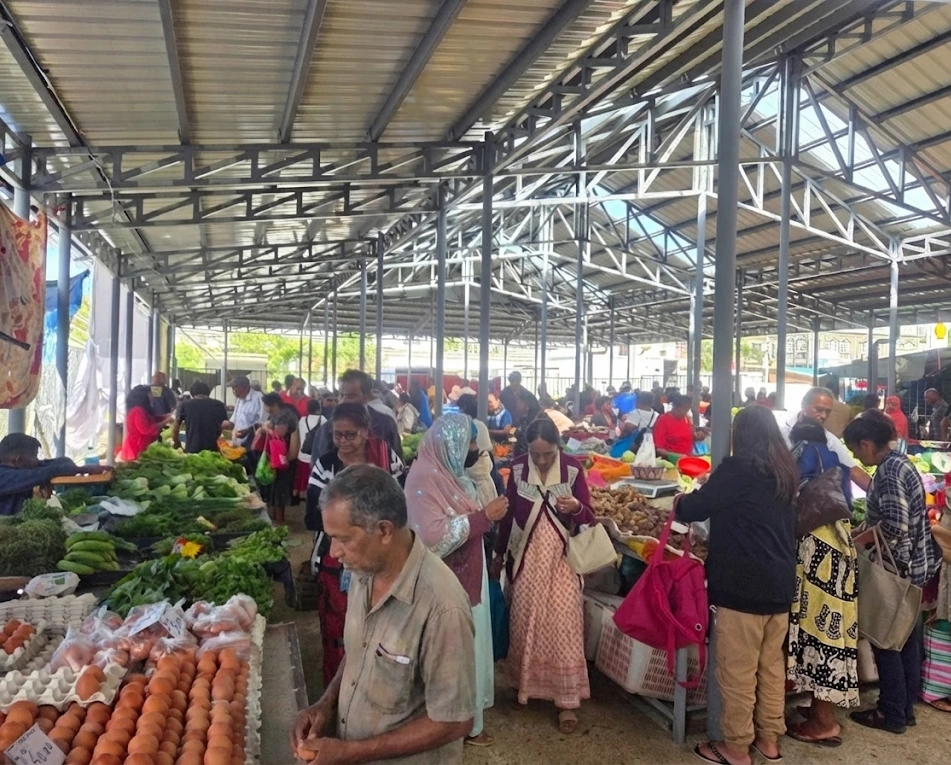
The Layout:
- The Produce Halls: This is the covered section. It smells of damp earth, coriander, ripe bananas, and butchery. It’s dark, cool, and intense.
- The Textile Streets: Open-air lanes lined with tents selling clothes. This is where the labyrinth begins. Sheets, curtains, t-shirts, underwear, it’s all flapping in the wind.
- The Food Court: Located usually at the far end or scattered throughout. You will know you are close by the smell of cumin and frying oil.
- The Bric-a-Brac: Piles of kitchenware, toys, plastic basins, and questionable electronics.
The Vibe:
Unlike the Central Market in Port Louis, which can feel aggressive with vendors practically dragging you into their stalls, Mahebourg feels communal. You will hear Creole shouted across stalls, “Eh, ki manyer?” (How are you?), and local music blasting from portable speakers, setting the mood for a fun day out similar to the best nightclubs in Mauritius. It is a “working” market—locals are here to buy their weekly socks and vegetables, not just souvenirs. You are a guest in their living room, so act accordingly.
5. Shopping Guide: Treasures to Find
Mahebourg is arguably the best place on the island for budget shopping. If you forgot your swimsuit, your sunglasses, or your entire personality, you can buy a new one here.
- Textiles: Mauritius produces clothes for many big European and American brands. You can find “surplus” stock (t-shirts, shorts, polo shirts) for incredibly cheap prices.
- The Catch: Sometimes the stitching is a bit wonky, or the crocodile logo looks like it’s having a panic attack. Check the quality before you buy.
- Fabrics: If you sew, the fabric selection here is serye (serious). Beautiful cottons and linens by the meter.
- Spices and Tea: Do not leave without buying spices. Vendors sell homemade masala blends for fish, chicken, or vegetable curries. These are not the stale powders you get in a supermarket jar; these are potent mixes that will clear your sinuses. Look for the famous “Bois Cheri” tea as well, often sold in bulk bags.
- Basketry: Vacoas baskets are a local specialty. Woven from the dried leaves of the pandanus plant, they are sustainable, strong, and look very chic. They are perfect for carrying all the other useless things you didn’t plan to buy but are currently holding.
- Fresh Produce: Even if you aren’t cooking, walk through the fruit section. Look for Letaber (small yellow fruit with a unique taste), Victoria Pineapples (the sweetest in the world, fight me), and “Snake Gourds” that look like green serpents.
- Souvenirs: Skip the tacky fridge magnets (okay, maybe buy one). Look for artisanal wooden ships. Mahebourg has a naval history, and the model ships here are detailed and beautiful, though the high-end ones are in showrooms, not on the dusty ground.
6. Food Guide: A Culinary Journey
You cannot visit Mahebourg Market without eating. It is legally forbidden (not really, but it should be). This is one of the best spots to experience the island’s culinary culture, much like finding the best places to eat in Flic en Flac. Do not look for a menu. Do not look for a waiter. Follow your nose.
Must-Try Dishes:
- Dholl Puri: The national dish of Mauritius. It is a soft, thin flatbread made from yellow split peas, filled with bean curry, tomato sauce (rougaille), spinach, and pickles.
- How to eat: It comes wrapped in paper. You have to tilt your head, unwrap slightly, and bite. If you don’t get curry on your shirt, did you even eat it?
- Where: Find the stall with the longest queue. Locals know best.
- Gato Pima (Chilli Cakes): Deep-fried balls of split peas, chillies, and coriander. They are crunchy on the outside, soft and doughy on the inside.
- Warning: They are addictive. You will buy a bag of ten “to share” and eat them all before you reach the next stall. Mari top (very good)!
- Mine Bouille: Boiled noodles tossed in soy sauce, topped with spring onions, and often served with a “bouillon” (soup) on the side.
- Pro Tip: Ask for an “Oeuf Roti” (roasted/braised egg) on top. It changes the game.
- Alouda: You will need to wash down the spice. Alouda is a sweet, pink milk drink thickened with agar-agar jelly (mousse) and basil seeds (tukmaria). It tastes like vanilla, rose water, and happiness.
- Vendor: Look for Pillay or Chez Soubiraj; they are legendary in the area.
- Merveille: A giant, crispy, fried dough cracker served with “Satini Cotomili” (green coriander chutney) and tomato sauce. It looks like a satellite dish made of dough. It’s messy, crunchy, and absolutely essential.
- Gateau Arouille: These are fritters made from grated taro root and ginger. They are sweet, savory, sticky, and crunchy all at once. If you see them fresh out of the fryer, buy them immediately.
7. Nearby Attractions: Make a Day of It
Since the market is a morning/early afternoon activity (and let’s be real, you can only look at vegetables for so long), combine it with these nearby sights for a full itinerary. Read our ultimate guide to Mauritius for even more ideas.
- The Waterfront: Just steps from the market. A paved promenade running along the immense lagoon of Grand Port. It’s the perfect place to walk off your Dholl Puri coma. The view of Lion Mountain across the bay is spectacular.
- History Check: Look for the memorial of the Battle of Grand Port (1810), the only naval victory for the Napoleonic French over the British. The French were so proud they carved it on the Arc de Triomphe in Paris.
- National History Museum (Naval Museum):
- Distance: ~1.5 km from the market (15-minute walk or 3-minute taxi).
- Why visit: Housed in the colonial mansion “Château Gheude,” it contains relics from the naval battles, cannons, old maps, and even the bones of a Dodo. It’s free, it’s cool inside, and it smells like old books.
- Biscuiterie Rault:
- Distance: ~3 km north of the market.
- Details: The oldest biscuit factory in Mauritius, operating since 1870. They make biscuits from manioc (cassava) using traditional methods that haven’t changed since the 19th century.
- Experience: Take a tour and enjoy tea and biscuits on their colonial veranda. It feels like stepping back in time, before the internet and stress existed.
8. Tips and Tricks for a Successful Visit
- Bring Small Change: Vendors struggle to change a 2000 MUR note. If you hand them a big note for a 10-rupee chilli cake, they will look at you with deep sadness. Carry 25, 50, and 100 MUR notes. To budget your trip better, use our Mauritius living cost calculator 2025.
- Dress Comfortably: It gets hot. Bien so (very hot). Wear light cotton clothes and comfortable walking shoes. The ground is uneven, and you might step in a puddle of mystery water.
- Haggle with a Smile: Bargaining is expected for textiles and souvenirs. Start at about 60-70% of the asking price.
- Rule: Do not haggle for food. The prices are fixed and very cheap. Asking for a discount on a 10-rupee fruit is bad karma.
- Watch Your Belongings: Mahebourg is generally safe, but pickpocketing can happen in dense crowds on Mondays. Keep your backpack on your front (the “pregnant kangaroo” look) or your wallet in a zipped front pocket.
- Hydrate: It gets very humid under the tarpaulins. Buy a fresh coconut (approx. 75–100 MUR) to drink while you walk. It’s nature’s Gatorade.
- Eco-Friendly: Plastic bags are technically banned or restricted, but often used. Bring your own reusable tote bag. It’s stronger for carrying heavy items and better for the island. Protez nou lagon (Protect our lagoon)!
- The “Non, Mersi” Technique: If a vendor is too pushy, a firm smile and “Non, mersi” works wonders. Keep walking. Do not make eye contact with the merchandise unless you want to buy it.
9. Conclusion
The Mahebourg Monday Market is more than just a shopping destination; it is a ritual. It preserves the “old Mauritius”, a place where interactions are personal, food is handmade, and the pace of life is dictated by the trade winds and the fishing boats.
It is a place where you can lose yourself in the crowd, eat until you can’t breathe, and buy a tablecloth you definitely don’t need but absolutely love. Whether you leave with a suitcase full of spices or just a full stomach and a memory of the vibrant colors, a trip to Mahebourg Market is essential for anyone wanting to understand the true culture of this island nation.
If you enjoy Mahebourg, there are several other vibrant markets across the island worth exploring, each with its own character, food culture, and shopping experience. You can find them all in our curated guide to the best local markets in Mauritius.
So, set your alarm clock, grab your reusable bag, and get ready to dive into the beautiful chaos. Ala prosen (See you next time)!
External Resources:
Tours and activities in the southeast
Hand-picked from GetYourGuide. Free cancellation on most bookings.
Some links on this page are affiliate links. If you book through them we may earn a small commission, at no extra cost to you. It helps keep Creole Mauritius free.


Questions and tips