
Mauritius Metro Express: Stations, Fares, Map & Timetable

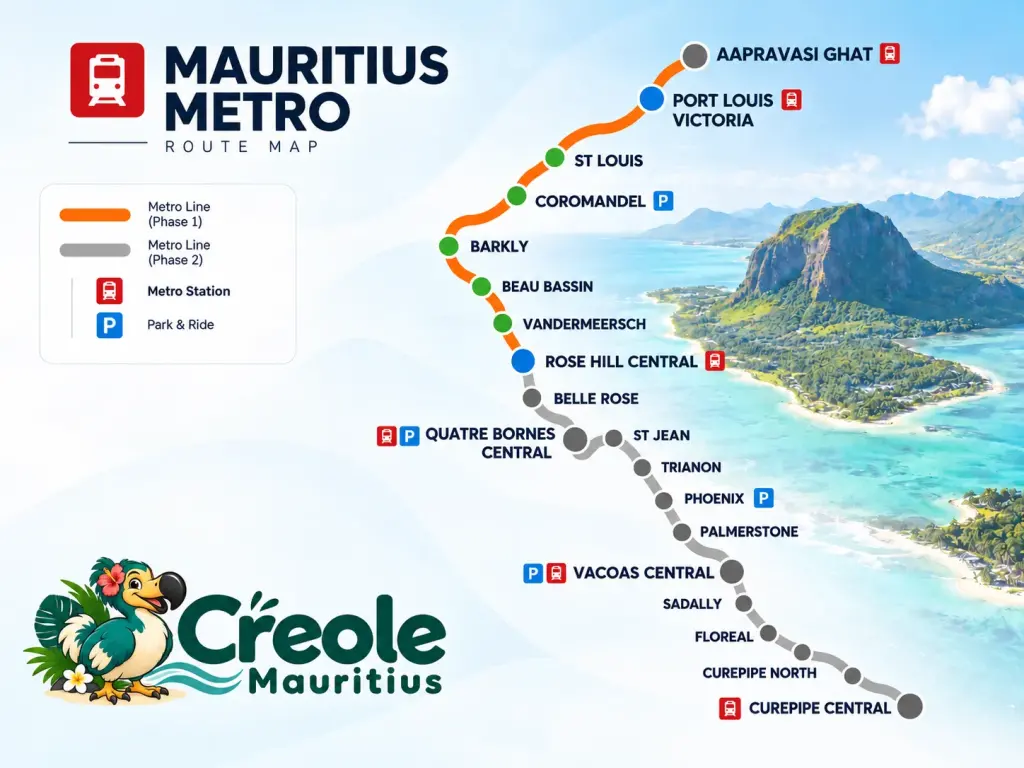
The Mauritius Metro Express runs through the central urban corridor from Port Louis to Curepipe, with a separate branch from Rose Hill to Ebène and Réduit. It is useful for travelling between major towns such as Port Louis, Rose Hill, Quatre Bornes, Phoenix, Vacoas and Curepipe, but it does not go to the airport, Grand Baie, Flic en Flac, Le Morne or the main beach resorts.
For most visitors, using it is simple. Buy a single-use ticket from the machine at the station, tap before boarding, take the train and tap again when you leave. A single journey currently costs between Rs35 and Rs55. If you expect to use the Metro several times, an MECard gives a slightly cheaper fare of approximately Rs32–52 depending on how far you travel.
This guide covers the complete station list, current fares, general operating hours and the practical things you need to know before using Metro Express in Mauritius.
| Quick Question | Answer |
|---|---|
| Where does the Metro go? | Port Louis to Curepipe, plus Rose Hill to Ebène and Réduit |
| How many stations? | 20 on the Port Louis–Curepipe corridor, plus 2 additional stations on the Réduit branch |
| General operating hours | 06:00–19:00 |
| Frequency | Approximately every 10 minutes under the standard timetable |
| Single ticket fare | Rs35–55 depending on distance |
| Adult MECard fare | Rs32–52 depending on distance |
| Airport connection? | No |
| Grand Baie or Flic en Flac? | No direct Metro service |
Metro schedules can change for public holidays, events and operational reasons. Check the official Metro Express website or station displays before a time-sensitive journey.
Mauritius Metro Stations
The main Metro line runs from Place d’Armes in Port Louis to Curepipe Central. There are 20 stations on this corridor.
| No. | Station | Useful For |
|---|---|---|
| 1 | Place d’Armes | Central Port Louis, waterfront, Government House and business district |
| 2 | Port Louis Victoria | Victoria Urban Terminal and connections to buses |
| 3 | St Louis | Central Port Louis neighbourhoods |
| 4 | Coromandel | Coromandel and park-and-ride connections |
| 5 | Barkly | Barkly and surrounding residential areas |
| 6 | Beau Bassin | Beau Bassin town centre |
| 7 | Vandermeersch | Rose Hill / Beau Bassin residential areas |
| 8 | Rose Hill Central | Rose Hill town centre, market, bus terminal and interchange for the Réduit branch |
| 9 | Belle Rose | Belle Rose and nearby residential areas |
| 10 | Quatre Bornes Central | Quatre Bornes town centre, market and bus connections |
| 11 | St Jean | St Jean Road and surrounding commercial areas |
| 12 | Trianon | Trianon area and nearby shopping/business districts |
| 13 | Phoenix | Phoenix town area |
| 14 | Phoenix Mall | Phoenix Mall and surrounding shopping area |
| 15 | Palmerston | Palmerston and nearby residential areas |
| 16 | Vacoas Central | Vacoas town centre, market and buses |
| 17 | Sadally | Southern Vacoas residential area |
| 18 | Floréal | Floréal and nearby central-plateau attractions |
| 19 | Curepipe North | Northern Curepipe |
| 20 | Curepipe Central | Curepipe town centre, market and regional bus connections |
The Ebène and Réduit branch
Metro Express also has a branch running from Rose Hill Central towards Réduit. If you are travelling from Port Louis or most stations on the Curepipe line, Rose Hill is the main interchange.
| Station | Useful For |
|---|---|
| Rose Hill Central | Interchange with the Port Louis–Curepipe line |
| Ebène Cybercity | Ebène business district |
| Mahatma Gandhi | Réduit, University of Mauritius, Open University and Mahatma Gandhi Institute area |
The Réduit branch can operate under a different timetable from the main Port Louis–Curepipe service, so check the live station information before travelling, particularly on weekends and public holidays.
Metro Express Timetable and Operating Hours
Metro Express currently advertises a standard service from approximately 06:00 to 19:00, with trains generally running around every 10 minutes.
| Service | Typical Schedule |
|---|---|
| First services | From around 06:00 |
| Last services | Around 19:00 |
| Standard frequency | Approximately every 10 minutes |
| Weekends / public holidays | Check official announcements because individual services can differ |
Unlike a long-distance railway, you generally do not need to plan around one particular train. In normal service, simply arrive at the station and check the electronic screen for the next departure.
Metro Express also publishes service changes for major events, engineering work and public holidays. If you need to make an important connection, leave additional time and check the latest information on the day.
Check the latest Metro Express journey information
How Much Does the Mauritius Metro Cost?
Metro fares depend on how many fare stages you travel through. There are five fare levels. For an ordinary visitor, there are two options: buy a single-use ticket or use an Adult MECard.
| Fare Stage | Adult MECard | Single-Use Ticket |
|---|---|---|
| Stage 1 | Rs32 | Rs35 |
| Stage 2 | Rs38 | Rs40 |
| Stage 3 | Rs43 | Rs45 |
| Stage 4 | Rs47 | Rs50 |
| Stage 5 | Rs52 | Rs55 |
In other words, even a journey covering most of the line costs only a little over Rs50.
Some useful examples:
| Journey | Single Ticket | Adult MECard |
|---|---|---|
| Place d’Armes → Port Louis Victoria | Rs35 | Rs32 |
| Place d’Armes → Rose Hill Central | Rs40 | Rs38 |
| Rose Hill Central → Mahatma Gandhi | Rs35 | Rs32 |
| Place d’Armes → Quatre Bornes Central | Rs45 | Rs43 |
| Place d’Armes → Phoenix Mall | Rs50 | Rs47 |
| Place d’Armes → Curepipe Central | Rs55 | Rs52 |
For most tourists making only one or two Metro journeys, I would simply buy single-use tickets. The saving from an MECard is relatively small unless you expect to use the Metro regularly.
If you are staying longer, commuting or making repeated trips between the central towns, an MECard becomes more convenient because you can top it up and tap on and off without purchasing another ticket each time.
How to Buy a Ticket and Use the Metro
Every Metro station has electronic ticket machines. You do not need an MECard to travel.
- Choose your destination at the electronic ticket machine.
- Buy a single-use ticket or use/top up your MECard.
- Tap on at the electronic validator before entering the platform.
- Check the display for the next train and destination.
- Board after passengers have left the train.
- Keep your ticket or card until you reach your destination.
- Tap off when leaving the station.
Do not forget the final tap. With an MECard, the system calculates the fare using the stations where you tap on and tap off. Failing to validate correctly can result in the maximum fare being charged and travelling without a valid ticket can be treated as fare evasion. Ticket machines can also be used to top up an Adult MECard. Metro Express states that the machines accept cash and bank cards.
Should a tourist buy an MECard?
For a visitor who only plans to travel from Port Louis to Rose Hill or Curepipe once, probably not. A single-use ticket is easier.
An MECard makes more sense if you are staying in Mauritius for several weeks, studying, working or regularly travelling between the towns on the Metro corridor. MECard fares are around 5–10% cheaper than equivalent single-use tickets.
There are also Student, Child, Senior and Priority cards, but these have specific eligibility and application rules. Tourists should not assume that an overseas student card or pensioner card automatically gives access to those fares.
Where the Mauritius Metro Does NOT Go
This is particularly important for tourists. Despite the name, Metro Express is not an island-wide railway system.
| Destination | Metro? | What to Use Instead |
|---|---|---|
| SSR International Airport | ❌ No | Bus, taxi, transfer or rental car |
| Grand Baie | ❌ No | Bus, taxi or car |
| Trou aux Biches | ❌ No | Bus, taxi or car |
| Flic en Flac | ❌ No | Bus, taxi or car |
| Tamarin / Black River | ❌ No | Bus, taxi or car |
| Le Morne | ❌ No | Car, taxi or organised transfer |
| Chamarel | ❌ No | Car, taxi or tour |
| Belle Mare | ❌ No | Bus, taxi or car |
| Mahébourg / Blue Bay | ❌ No | Bus, taxi or car |
The Metro is best thought of as the backbone of the densely populated Port Louis–central plateau corridor, not as transport between the island’s beach resorts. If your destination is not on the Metro network, our Mauritius transport guide compares buses, taxis, rental cars and the Metro. For bus routes and fares specifically, use our Mauritius bus guide.
Useful Metro Stations for Visitors
Place d’Armes is the most useful stop for central Port Louis. From here you can walk towards the waterfront, Government House and much of the central business district.
Port Louis Victoria is particularly useful if you need to change from the Metro to a bus. Victoria Urban Terminal serves numerous routes heading towards other parts of Mauritius.
Rose Hill Central is one of the network’s most important interchange stations. It connects the main line with the Ebène–Réduit branch and sits beside a major bus terminal. Rose Hill is also a good place for inexpensive local food.
Quatre Bornes Central is useful for the town centre, market and bus connections towards areas not served by rail.
Phoenix Mall gives direct access to one of the island’s major shopping areas.
Vacoas Central and Curepipe Central are both useful bus interchanges if you are travelling farther south or east.
If you are using the Metro to explore Port Louis rather than commute, combine it with our Port Louis street food guide.
Is the Metro Express Useful for Tourists?
Yes, but only if your itinerary actually takes you through the central towns. If you are staying at a beach resort in Grand Baie, Belle Mare or Le Morne, the Metro will probably play a very small role in your holiday. There is no direct rail connection from the airport or to the major coastal resort areas.
It becomes much more useful if you are staying around Port Louis, Beau Bassin, Rose Hill, Quatre Bornes, Ebène, Phoenix, Vacoas or Curepipe. It is also convenient for visitors who want to explore Port Louis without driving into the capital and dealing with traffic and parking.
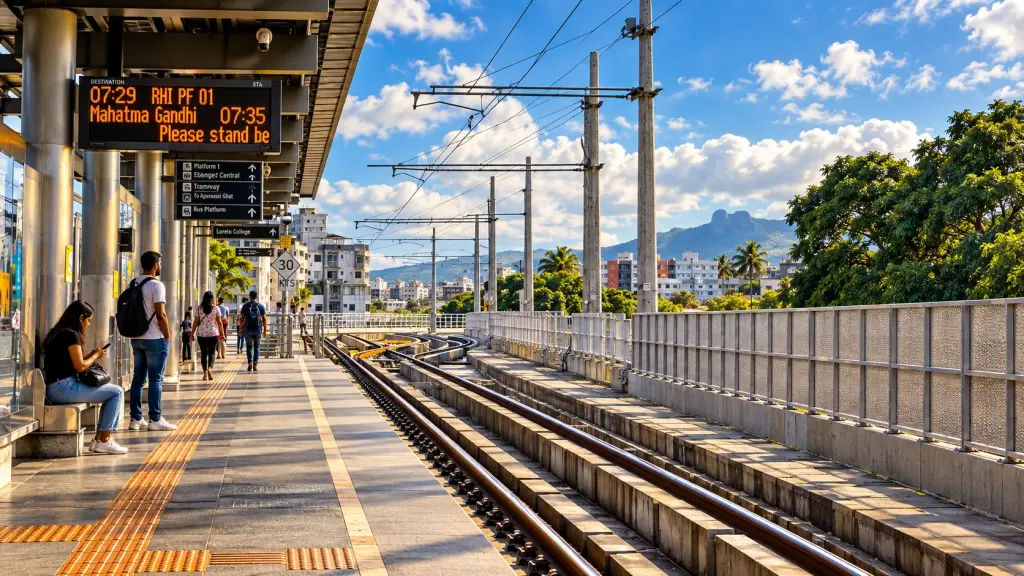
The trains are air-conditioned and accessible, with low-floor boarding, space for wheelchairs and pushchairs, electronic displays and audible station announcements. Eating and drinking are not allowed onboard.
For a first-time tourist, the most useful rule is simple: use the Metro for the central urban corridor and use buses, taxis or a rental car for the beaches and the rest of the island.
Official Metro Express Information
- Metro Express – Journey Planner, Fares and Ticket Information
- Official Metro Express Website
- Metro Express Contact and Ticket Office Information
Fares, operating hours and services can change. Always check station displays or the official Metro Express website before a time-sensitive journey.



I’m having trouble locating how much the tickets and card actually cost and if they can be purchased online before I arrive in the country (single fare as we are only there for a day. )
The MECard Adult and Single-use Tickets can be purchased at the electronic self-service ticket machines at all stations. The price for MECard is Rs 150 and includes Rs 100 credit.