
The History of Mauritian Music – From Sega to Seggae

The history of Mauritian music is far more than a record of simple entertainment; it is a living chronicle of the island’s complex past, a celebration of its multicultural identity, and a profound expression of resilience that has survived centuries of transformation. Situated at the crossroads of Africa, Asia, and Europe, the island has produced one of the most distinctive and culturally significant musical traditions in the Indian Ocean region.
From the haunting, rhythmic beats of traditional Sega to the revolutionary fusion of Seggae, the history of Mauritian music represents the voice of a people who have endured extraordinary hardship and emerged to create something uniquely beautiful and universally meaningful. This article traces the history of Mauritian music chronologically, examining how its evolution has mirrored the social and cultural development of the nation. For a broader understanding of the island’s heritage, you can also explore our Simple guide to Mauritian culture.
Contents
Late 17th Century – 19th Century: The Origins of Sega
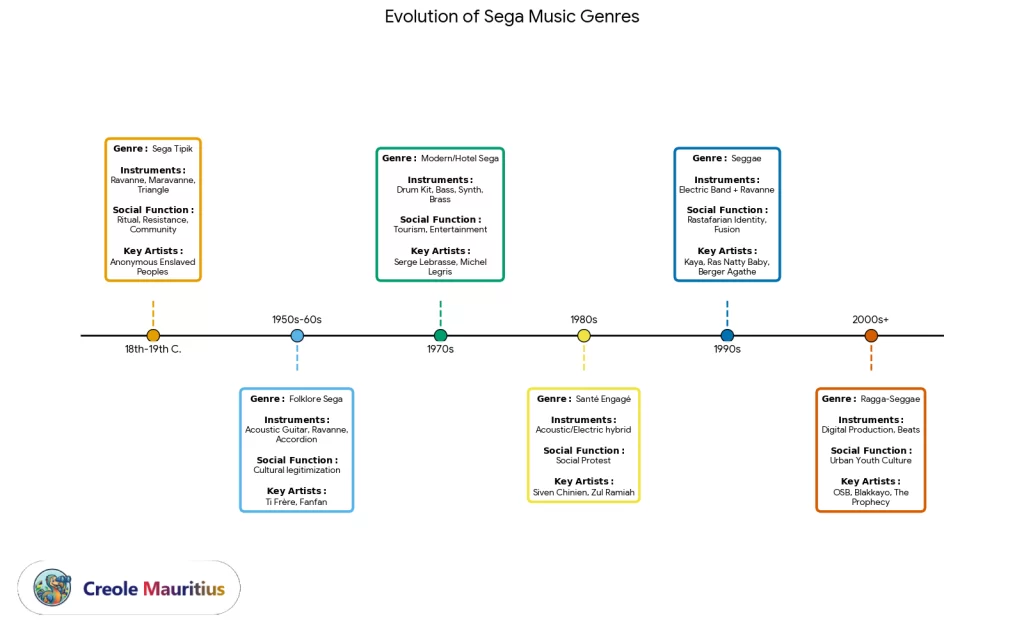
The history of Mauritian music begins during one of humanity’s darkest chapters, the era of colonization and slavery. Sega music emerged in the late 17th to early 18th century, primarily among enslaved populations brought to the island from West Africa, Mozambique, Zanzibar, and Madagascar. These individuals carried with them the rhythms, musical traditions, and spiritual practices of their homelands. Unable to practice their ancestral religions openly or maintain their cultural institutions, these enslaved populations developed Sega as a vital form of expression.
A Sanctuary of Resilience in The History of Mauritian Music
For those living under brutal conditions on the island’s sugar plantations, Sega became more than music; it was psychological comfort, a means of maintaining human dignity, and a pathway to social cohesion in dehumanizing circumstances. While the exact date remains unclear, this period marks the foundational chapter in the history of Mauritian music, with most scholars placing its genesis in the late 17th century during the French colonization of Mauritius.
Historical accounts suggest that Sega was performed primarily at night, often around large bonfires hidden away from the prying eyes of plantation owners. These nocturnal gatherings served ritualistic and ceremonial purposes within enslaved communities. They provided rare moments of freedom and self-expression. The bonfire was central not only for its light but for its practical utility in the mechanics of early Mauritian music history: the heat was essential to warm the goat-skin drums, tightening the hide to maintain the instrument’s pitch and resonance throughout the damp tropical nights.
The Instruments of Tradition
The musical architecture of traditional Sega was built upon a foundation of percussion instruments that remain largely unchanged throughout the history of Mauritian music, though played with increasing sophistication over the centuries.
- The Ravanne: This is the heartbeat of Sega and a cornerstone in the history of Mauritian music. It is a large frame drum made from goat skin stretched over a wooden circular frame. Ranging from 30 to 70 centimeters in diameter, the ravanne is struck with the hands, requiring the player (called a “ravannier” or “tanbouyé”) to sit, crouch, or stand with one leg elevated to keep the instrument positioned on the thigh. The skin must be regularly warmed to remain tight, a requirement that historically necessitated the bonfires.
- The Maravanne: This instrument provides the rhythmic “shaker” sound essential to the genre. It is a thin rectangular box constructed from dried sugar cane flower stems and filled with dried seeds or small pebbles. When shaken, it produces a crisp, high-pitched rhythmic sound that mimics the sound of the ocean or rain.
- The Triangle: A metal bar bent into a triangle shape and played with a small metal rod, adding a metallic percussion layer that cuts through the deeper tones of the drum.
Some regional variations historically included the moutia (a hand drum) and the bobre (a bow instrument), though these are less common in the modern standard narrative of the history of Mauritian music.
The Dance: Movement and Meaning
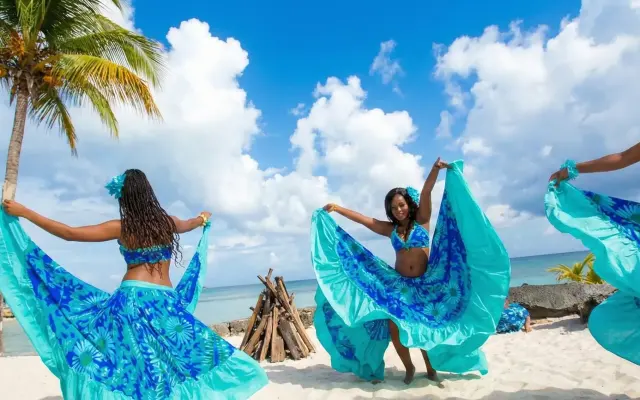
Sega is fundamentally a complete performance art—encompassing music, song, and dance. The Sega dance in Mauritius is distinctly simple in its basic structure yet infinitely varied in its execution. Throughout the history of Mauritian music, the dance evolved from its original context on the island’s sandy beaches and dirt floors. Because dancers’ feet could not lift from the sand without creating visible marks or losing balance, a characteristic shuffling movement developed. Performers do not lift their feet high but rather slide them along the ground, creating a distinctive gliding effect known as the “shuffling” step.
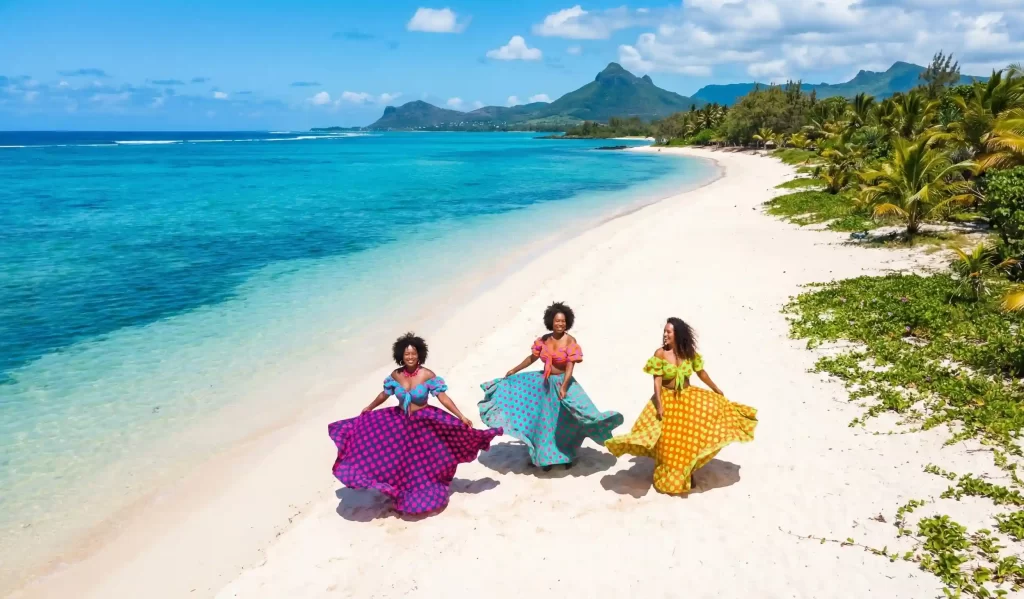
The dance typically begins with a man standing with hands placed on his hips, moving them rhythmically while awaiting his dance partner. Once partners face each other, the tempo increases, and the hip movements become faster and more pronounced. Dancers lower their bodies by bending the knees while swaying, creating an effect that was often described by colonial observers as erotic, though for the participants, it was a joyful expression of community and vitality.
Early 20th Century – 1950s: From Taboo to Recognition
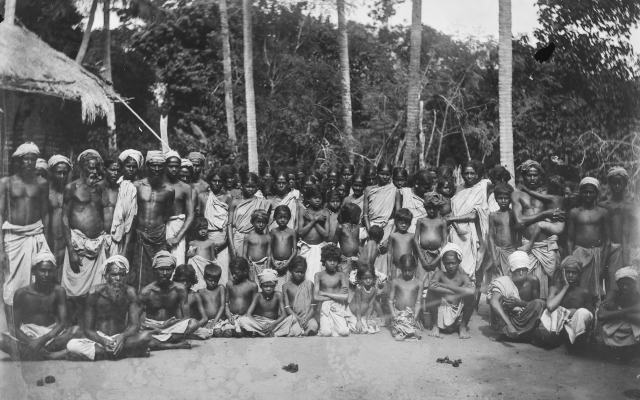
For much of the 19th and early 20th centuries, the journey of Sega within the history of Mauritian music faced significant hurdles. It was viewed with suspicion and shame by many within the island’s more conservative social strata. The Catholic Church and colonial authorities often actively discouraged the practice, condemning the dance movements and associating the music with lower socioeconomic classes.
The Cultural Turning Point (1948)
A pivotal moment in the history of Mauritian music occurred in 1948. A legendary musician named Ti Frère (born Jean Alphonse Ravaton) recorded the first 45-rpm vinyl record ever released in Mauritius, featuring the iconic song “Papitou.”
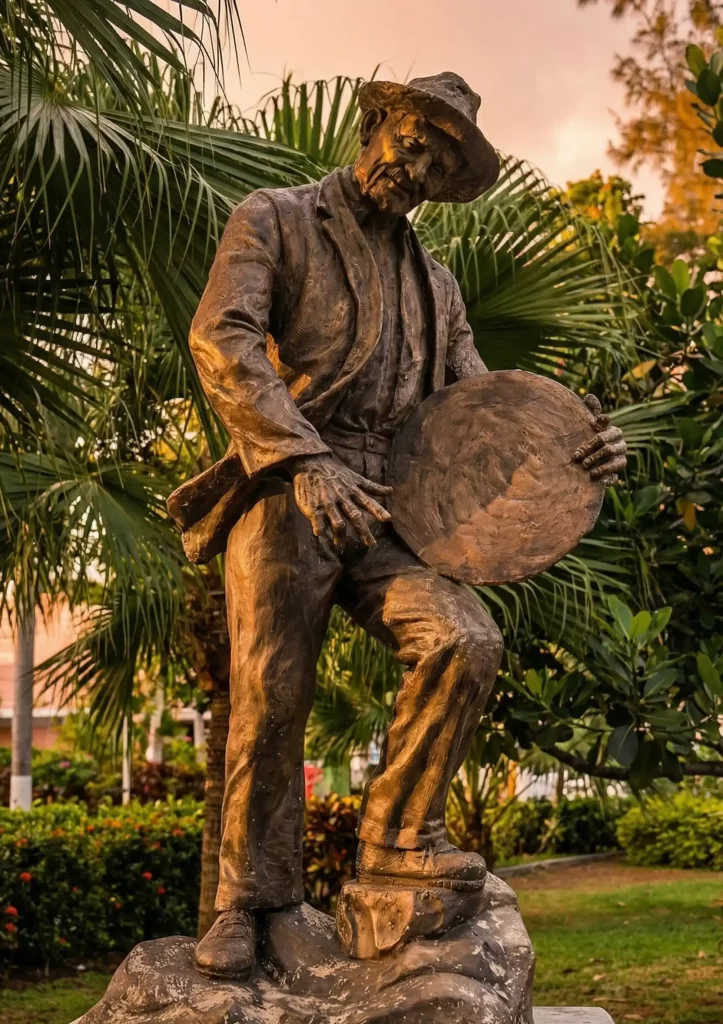
Ti Frère is widely and rightfully regarded as the “Father of Sega.” His genius lay in his ability to bridge the gap between the raw, traditional “Sega Tipik” of the rural areas and a wider, more urban audience. He introduced the diatonic accordion to the traditional ensemble, blending the African rhythmic roots with European melodic influences such as polka and quadrilles. This “civilized” form of Sega appealed to broader audiences while maintaining the genre’s essential rhythmic character. Ti Frère’s recording became an instant hit, proving that the local sound had commercial viability and cultural worth, forever altering the history of Mauritian music.
1960s – 1970s: Independence and the Golden Age
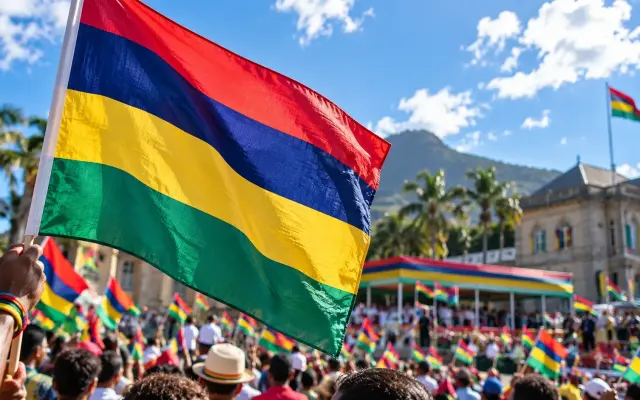
The era surrounding the independence of Mauritius in 1968 coincided with a profound cultural renaissance. As the nation forged its new identity separate from British rule, the history of Mauritian music entered a new phase where Sega became a powerful symbol of national pride, transcending ethnic and social divides to become a unifying force.
“La Nuit du Sega” (1964)
A defining moment in the history of Mauritian music took place on October 30, 1964, with an event known as “La Nuit du Sega” (The Night of Sega) held at the foot of Le Morne Brabant mountain. This location was symbolic, as Le Morne was a refuge for escaped slaves (maroons) and remains a sacred site of resistance. The event showcased Ti Frère and helped catapult Sega onto the national stage, moving it from private gatherings to public celebration. Following this breakthrough, a new generation of artists emerged, including Serge Lebrasse, who moved to Ti Frère’s village and became instrumental in spreading the music island-wide.
Music as a Unifying Force
The period leading up to independence was fraught with tension. The 1968 race riots threatened to tear the social fabric of the island apart. During this volatile period, the history of Mauritian music shows how musicians consciously used their platform to promote peace and coexistence. Artists composed songs explicitly encouraging multiethnic unity. Famous examples like “Lame dan lame” (Hand in Hand) featured multiple musical styles associated with different cultural groups and lyrics sung in Bhojpuri and Creole, encouraging listeners to look beyond ethnic differences. This established Sega not just as entertainment, but as a crucial tool for social cohesion.
Modernization and the Electric Era
As the 1970s progressed, the history of Mauritian music saw the absorption of global influences. The traditional acoustic ensemble was expanded to include electric guitars, bass, keyboards, and drum kits. This era, often referred to as the “Golden Age” of Sega, saw the rise of artists like Roger and Marie-Josée Clency, Alain Permal, and Georgie Joe.
The music became faster, funkier, and more polished, incorporating elements of soul, jazz, and pop music from the West. Despite these modern additions, the core elements remained: the Mauritian Creole language, the call-and-response vocal structure, and the infectious, driving rhythm. Sega had successfully transitioned from the bonfires of the past to the recording studios, hotels, and dancehalls of the modern era, cementing its place in the history of Mauritian music as the de facto national sound.
1980s – 1990s: The Birth of Seggae and Social Commentary
While Sega was the sound of tradition and celebration, the late 20th century birthed a new genre that changed the history of Mauritian music forever, speaking to the complexities, struggles, and aspirations of modern Mauritian society: Seggae.
The Influence of Reggae and Rastafarianism
In the 1980s, global interest in Reggae music, led by the icon Bob Marley, reached the shores of Mauritius. The themes of Reggae, social justice, anti-colonialism, spirituality, and the struggle of the African diaspora, resonated deeply with many Mauritians, particularly within the Creole community. A young musician from the working-class neighborhood of Roche-Bois named Joseph Réginald Topize, known by his stage name Kaya, was deeply influenced by this movement.

Kaya initially performed Reggae covers with his band Racinetatan (named after a Malagasy prince exiled in Mauritius). However, he gradually came to a realization: while he loved Reggae, it was distinctly Jamaican. It did not fully capture the specific rhythm of the Mauritian soul. He sought a sound that would reflect the Mauritian reality while retaining the “roots and culture” philosophy of Reggae.
The Revolutionary Fusion: Seggae
Kaya’s solution was an act of musical genius that redefined the history of Mauritian music: he fused the slow, bass-heavy, off-beat skank of Reggae with the faster, ternary rhythm of traditional Sega. The result was Seggae.
This new genre emerged fully formed in the late 1980s. Unlike the often celebratory nature of mainstream commercial Sega, Seggae was introspective, spiritual, and socially conscious. It maintained the ravanne’s driving beat but slowed it down to a groove that allowed for heavier basslines and more complex lyrical delivery.
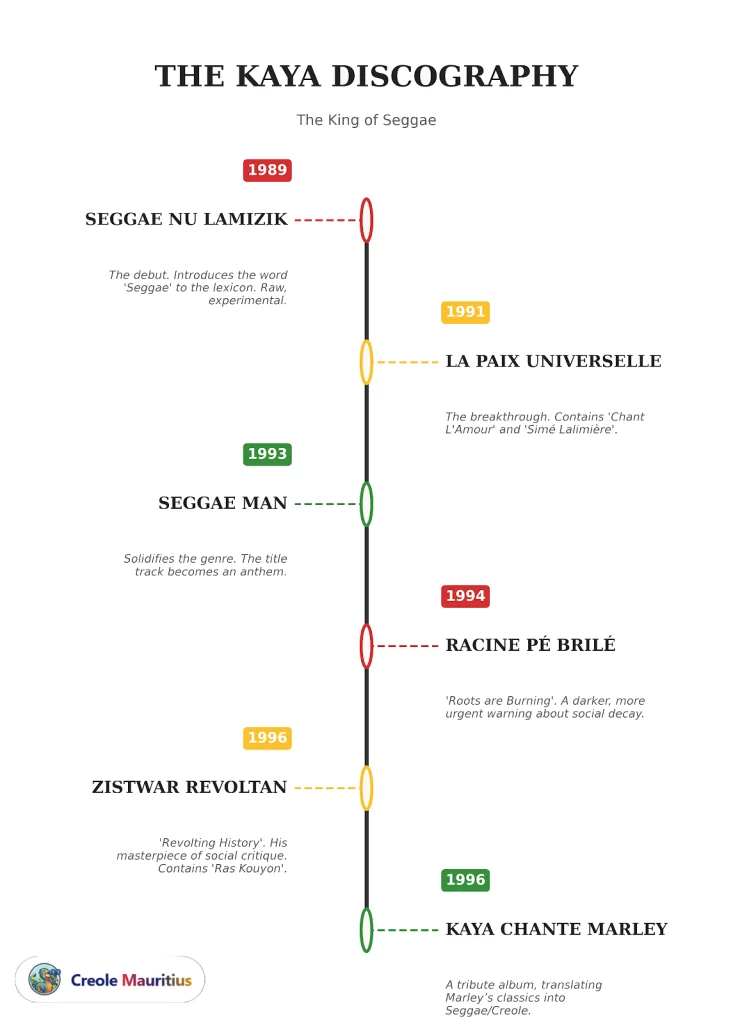
Seggae addressed themes of inequality, poverty, identity, peace, and cultural harmony. Kaya’s lyrics, sung primarily in Creole, became anthems for a generation seeking dignity and recognition. Songs like “Simé la limiere” (The Road to Light) and “Ras Kouyon” became legendary markers in the history of Mauritian music.
The Movement Expands
Kaya was not alone in this movement. Other artists played significant roles in popularizing the genre. Ras Natty Baby (Joseph-Nicolas Emilien), originally from Rodrigues Island, became a major force with his album “Nouvelle Vision” in 1990. While Kaya’s style was often more spiritual and introspective, Ras Natty Baby brought a different energy that helped spread Seggae across the Indian Ocean islands and into Europe.
Another notable group, the Otentik Street Brothers (OSB), emerged in the early 90s. Led by Bruno Raya, OSB incorporated influences from Jamaican dancehall and hip-hop, bringing a harder, urban edge to the music and fighting explicitly for the recognition of Creole cultural identity.
The Legacy of 1999
The late 1990s were a turbulent time for the history of Mauritian music. On February 21, 1999, Kaya passed away while in police custody, an event that triggered significant social unrest known as the “Kaya riots.” His death was a traumatic moment for the nation, highlighting deep-seated social grievances. However, it also cemented his legacy as a cultural icon and a martyr for his message of peace and unity.
In the years following his death, Kaya’s music transcended its initial audience to become beloved by all Mauritians. Seggae remains a vital genre in Mauritius, a permanent testament to the island’s ability to innovate and adapt global influences into something uniquely its own.
2000s – Present: UNESCO Recognition and Global Reach
Entering the 21st century, the history of Mauritian music continued to evolve while gaining prestigious international recognition, solidifying its place in the global cultural landscape.
UNESCO Intangible Cultural Heritage
In a monumental validation of its cultural importance, traditional Mauritian Sega was inscribed on the UNESCO Representative List of the Intangible Cultural Heritage of Humanity in 2014. This recognition acknowledged Sega not just as a musical genre, but as a comprehensive cultural practice involving song, dance, and language that fosters social cohesion and preserves collective memory.
The recognition did not stop there. In 2017, the Sega Tambour of Rodrigues Island was inscribed, followed by the Sega Tambour Chagos in 2019. These inclusions highlighted the diverse musical traditions across the Republic of Mauritius, ensuring that the specific regional variations of the music are preserved for future generations.
Other Musical Traditions: Bhojpuri and Moutya
Beyond Sega and Seggae, the 21st century has seen a revival and appreciation of other musical forms within the history of Mauritian music.
- Bhojpuri Music: Influenced by the indentured laborers from India, Bhojpuri music has developed distinctly Mauritian characteristics. Artists like The Bhojpuri Boys have popularized a fusion sound that blends traditional Indian instruments like the tabla and harmonium with the driving rhythms of Sega. This “Chutney-Sega” or “Bhojpuri-Sega” is a staple at weddings and cultural festivals.
- Moutya: Closely related to Sega but with distinct characteristics, Moutya is another rhythm born of the enslaved experience, shared with the Seychelles. It has seen a resurgence as artists look back to the deepest roots of Indian Ocean heritage.
Contemporary Evolution and the Diaspora
Today, the Mauritian music scene is more diverse and professional than ever before. A new generation of artists is reinventing traditional sounds for a digital, global audience, writing the next chapter in the history of Mauritian music.
- Global Fusion: Artists like Les Zilwa and Jason Heerah are producing music with high production values that appeal to international ears. Jason Heerah, based in Australia but deeply connected to his Mauritian roots, has demonstrated the viability of blending Sega with soul, reggae, and pop, earning accolades and bridging the gap between the diaspora and the island.
- The New Wave: Artists such as The Prophecy continue the legacy of roots Seggae, while newer acts blend Sega with Afrobeat and Dancehall, reflecting the island’s connection to the broader African continent. Songs are now streamed globally, and Mauritian artists regularly tour Europe and Australia.
- Festivals: Events like the “Reggae donn sa” festival continue to celebrate the legacy of Seggae, ensuring that the message of pioneers like Kaya remains relevant to the youth of today.
For those visiting the island, experiencing live music is a must. Many hotels and cultural centers host Sega nights, but for a more authentic experience, visitors might encounter spontaneous performances on public beaches on weekends. Understanding the spiritual context of these performances can be enhanced by reading about religion in Mauritius, which provides background on the festivals where music plays a central role.
Conclusion: Music as Cultural Memory
The history of Mauritian music is a timeline of the island itself. It began in the shadows of the 17th century as a cry for dignity, evolved through the 20th century as a symbol of national identity, and transformed in the late 20th century into a voice for social consciousness.

From the traditional Ravanniers keeping the beat alive around a fire to the modern Seggae bands filling stadiums, the music remains the island’s most potent storytelling medium. It preserves the past, critiques the present, and unites the diverse population of Mauritius under a single, rhythmic identity. The Sega and Seggae are not just genres of music; they are the heartbeat of the nation.
Whether you are exploring the hidden gems in Mauritius or simply enjoying the sunset, the sound of the Ravanne is never far away, reminding all who listen of the enduring spirit, the pain, the joy, and the resilience of the Mauritian people.
External Sources:
Tours and activities in Mauritius
Hand-picked from GetYourGuide. Free cancellation on most bookings.
Some links on this page are affiliate links. If you book through them we may earn a small commission, at no extra cost to you. It helps keep Creole Mauritius free.

Questions and tips