
The History of Mauritian Creole: From Past to Present
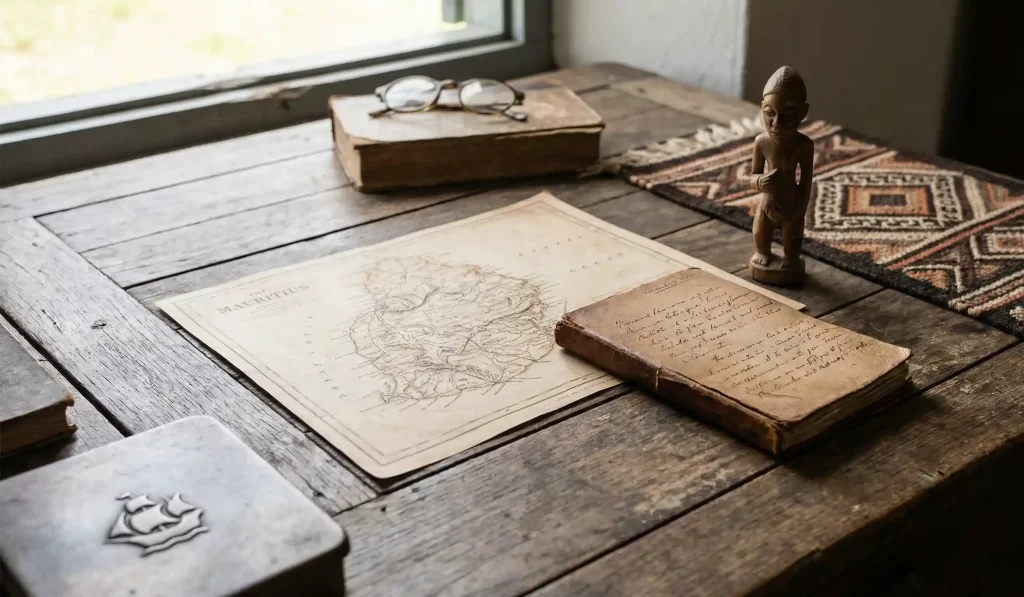
When you step off the plane in Mauritius, you are greeted by a symphony of sounds. You might hear the crisp announcements in English and the polite chatter of tourists in French. But if you listen closely to the taxi drivers joking in the parking lot or the market vendors shouting prices in Port Louis, you will hear the true heartbeat of the island.
You are hearing Kreol Morisien (Mauritian Creole).
For a long time, outsiders dismissed it as “broken French” or a simple dialect. They were wrong. At Creole Mauritius, we know that our language is a linguistic miracle. It is a complex, vibrant, and incredibly efficient language that was born out of necessity and grew into a symbol of national identity.
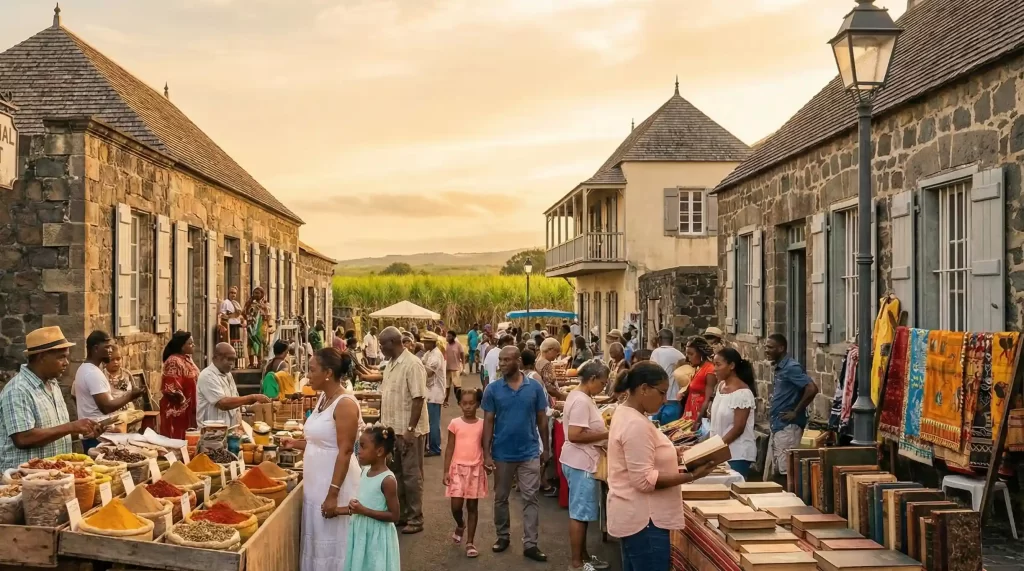
It is the language of our segas, our arguments, our jokes, and our love stories. But how did a language that didn’t exist 300 years ago become the mother tongue of 90% of the population? Grab a cup of tea (or maybe a Phoenix beer), and let us take you on a journey through time and explore the history of Mauritinan Creole.
Contents
The Birth of a Language (18th Century)
To understand Kreol, we have to go back to the early 1700s. The French had just taken control of the island, naming it Île de France. They brought with them settlers, administrators, and soldiers who spoke standard French and various regional French dialects.
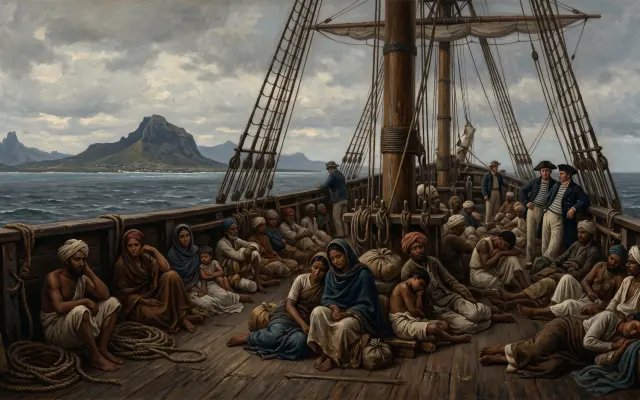
But the linguistic landscape changed dramatically with the arrival of enslaved people from East Africa, specifically Mozambique and Madagascar, as well as West Africa. Between 1715 and 1810, thousands of people arrived on these shores speaking at least six major languages, including Malagasy, Tamil, Bengali, Gbe, Wolof, and Manding.
Here is the problem: The French settlers couldn’t understand the enslaved people. The enslaved people couldn’t understand the French. And often, the enslaved people couldn’t even understand each other because they came from different linguistic regions.
The “Linguistic Emergency”
Imagine being dropped on an island where everyone speaks a different language, but you need to communicate immediately to survive, work, and function. You don’t have time for Duolingo lessons. You need a common tongue right now.
This is where the magic happened. Contrary to the old belief that enslaved people were just “badly learning” French, modern linguists suggest something much more dynamic occurred. Everyone present on the island engaged in a mutual search for communication.
They took the vocabulary of the dominant power (French) but stripped away the unnecessary complications (like the eighteen different ways to conjugate a verb) and restructured it using the grammatical logic of African languages. It wasn’t a simplified version of French; it was a brand new operating system running on French hardware.
From Pidgin to Creole: A Rapid Evolution
Usually, when two groups with no common language meet, they develop a “pidgin.” A pidgin is a rudimentary communication system with limited vocabulary and no native speakers. It is what you use to buy fish or give basic orders.
But in Mauritius, something extraordinary happened. The transition from a pidgin to a fully-fledged Creole happened at warp speed.
By the late 18th century, travelers were already documenting this new “patois.” Bernardin de St. Pierre, who wrote Voyage à l’Ile de France in 1773, noted that the language was already structurally similar to the Kreol we speak today. This means the language solidified within just a few generations.
The Nativization Threshold The critical moment came when children started being born on the island. For these children, this “contact language” wasn’t a second option; it was their first language. Once a generation of children adopts a pidgin as their mother tongue, it expands. It gains complexity, nuance, and depth because it needs to express every human emotion, not just work instructions.
The Ingredients of the Soup: Linguistic Influences
If Kreol were a dish, it would be a fusion curry. The base is French, but the spices are undeniably African and Malagasy.
The French Superstrate
Most of the vocabulary comes from French. If you speak French, you will recognize words like manzer (manger/to eat), vini (venir/to come), or lakaz (la case/house). However, the pronunciation changed. The complex consonant clusters of French were simplified to make them easier to pronounce in a flow. For example, the French word pouvoir (power/to be able to) became puvwar in Kreol.
The African and Malagasy Substrate
While the words sound French, the way we use them is often African. The syntax (sentence structure) and phonology (sound system) show deep influences from the Bantu and Malagasy languages.
For instance, the use of nasal vowels and the specific way verbs are sequenced reflect the African origins of the speakers. We didn’t just borrow words; we transferred the way we organized our thoughts from our ancestral languages into this new medium.
The Asian Layer
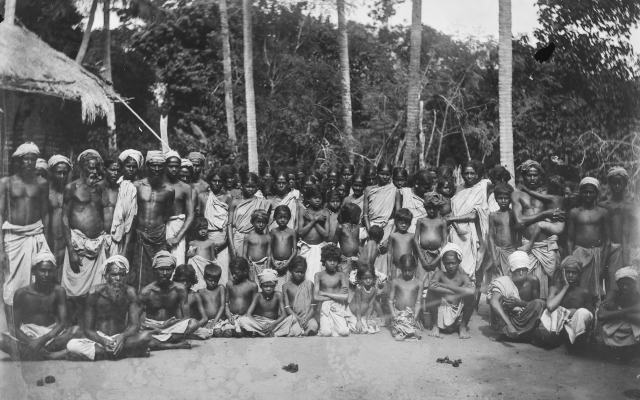
After slavery was abolished in 1835, the British (who had taken over the island in 1810) brought in indentured laborers from India. Approximately 700,000 people arrived from Bihar, Uttar Pradesh, Tamil Nadu, and Maharashtra.
They brought their own languages (Bhojpuri, Tamil, Telugu, Marathi). While they initially kept these languages within their communities, they also adopted Kreol to communicate with the rest of the population. Over time, Indian words seeped into the Creole vocabulary, especially regarding food, religion, and clothing.
This is why, when you read our guide on must-try foods in Mauritius, you will see words that have clear Indian roots sitting comfortably alongside French-derived terms. If you want to explore the diversity of our language further, check out our Mauritian Creole Vocabulary list to see how many words you might already recognize.
Grammar for Geeks: It’s Not Simple, It’s Efficient
There is a myth that Creole languages have “no grammar.” This is nonsense. Kreol Morisien has a very strict, logical grammar system. It just happens to be much more efficient than French.
1. The Verb System In French, you have to conjugate a verb depending on who is speaking, when it happened, and the mood. It is a nightmare for students. In Kreol, the verb stays the same. Ale (to go) is always ale. We use “markers” before the verb to indicate time:
- Ti: Past tense (Mo ti ale = I went)
- Pe: Progressive/Present Continuous (Mo pe ale = I am going)
- Pou: Future (Mo pou ale = I will go)
It is clean, precise, and logical.
2. Pronouns We don’t change pronouns based on whether they are the subject or object.
- Mo: I / Me / My
- To: You / Your
- Li: He / She / It In French, you have je, me, moi, mon, ma, mes. In Kreol, Mo does all the heavy lifting.
3. Questions We don’t invert the word order to ask a question. We just raise our voice at the end.
- To pe vini? (You are coming?) It relies on intonation, which makes the language sound musical and expressive.
If you are intrigued by this logic and want to master the basics yourself, our Mauritian Creole lessons are the perfect place to start.
The Struggle for Respect
Despite being the language that literally everyone spoke, Kreol had a rough childhood. For centuries, it was stigmatized. The colonial administration, and later the elite, viewed it as a “corruption” of French. It was the language of the kitchen, the field, and the street, but never the classroom or the parliament.
The “Poor Cousin” Syndrome
This stigma had real consequences. In schools, children were often punished for speaking Kreol. French was the language of “civilization” and education. This created a strange psychological split where people would think in Kreol, joke in Kreol, and dream in Kreol, but feel ashamed to use it in formal settings.
While ancestral languages like Hindi, Urdu, and Mandarin were given space in the curriculum to honor the diverse heritage of the population, Kreol—the one language that united everyone—was left out in the cold.
The Turning Point (2012)
Things started to change in the 21st century. As our sense of national identity grew, so did our pride in our language. In 2012, a historic milestone was reached: Kreol Morisien was officially introduced as an optional subject in primary schools.
Finally, children could learn the grammar and spelling of their mother tongue. It was a validation that their language was worthy of ink and paper.
Culture, Music, and Identity
You cannot separate the language from the culture. Kreol is the vehicle for the Sega, our national music. When you listen to the rhythmic beating of the Ravanne and the call-and-response lyrics, you are hearing the soul of the island.
In the late 20th century, a musician named Kaya created Seggae (a fusion of Sega and Reggae). He used Kreol to sing about social justice, love, and unity. His music proved that Kreol could be profound, poetic, and revolutionary. Read more on the history of Mauritian Music here.
Today, Kreol is everywhere. It is in the nightclubs, on the radio, and in literature. Writers and poets are publishing books in Kreol, proving that it is capable of high art. If you are interested in local expressions, check out our culture section to learn a few phrases.
The Modern Paradox
Here we are in 2025. Mauritius is a modern, thriving nation. We have high-speed internet (perfect for the digital nomad life), we have a stock exchange, and we have a 90% literacy rate.
The Statistic: According to the 2022 census, roughly 90% of Mauritians speak Kreol as their home language. Compare that to French (4.4%) or English (0.6%).
The Paradox: Despite this overwhelming dominance, Kreol is still not an “official” language in the Constitution. English is the official language of Parliament (though French is allowed). Laws are written in English. The media is a mix of French and Kreol.
Some argue this is a hangover from colonial times. Others say that keeping English as the “neutral” official language helps us connect with the global economy. Regardless of the politics, the reality on the ground is clear: Kreol is the boss. It is the only language that a Hindu grandmother, a Chinese shopkeeper, and a Franco-Mauritian landowner can use to have a conversation.
Conclusion: The Glue That Holds Us Together
The history of Mauritian Creole is a story of survival. It started as a desperate attempt by oppressed people to understand one another. Against all odds, it didn’t just survive; it thrived.
It borrowed from three continents to create something unique. It is a language that refuses to be complicated for the sake of it. It cuts to the chase. It is warm, funny, and direct.
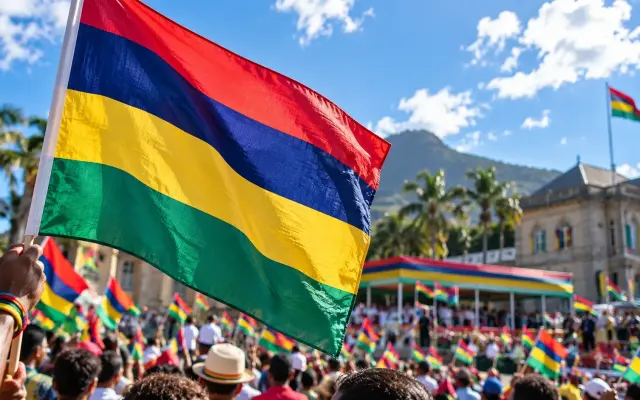
Today, it is the glue that holds our multicultural society together. It is the reason we can have a “Mauritian” identity that transcends race and religion. Whether you are bargaining at the Flacq market or ordering street food, speaking a few words of Kreol unlocks a different side of the island.
So, the next time you visit, don’t just stick to “Bonjour.” Try a “Ki manyer?” (How are you?). You will see the difference in the smiles you get back.
Want to learn more about our island’s heritage? Explore our Culture Category for more stories.
External Resources:
Tours and activities in Mauritius
Hand-picked from GetYourGuide. Free cancellation on most bookings.
Some links on this page are affiliate links. If you book through them we may earn a small commission, at no extra cost to you. It helps keep Creole Mauritius free.

Questions and tips