
How to Invest in the Stock Exchange of Mauritius
Want to buy shares in MCB, SBM or another company listed on the Stock Exchange of Mauritius? You don’t need a large investment portfolio or a background in finance to get started. The process begins with opening a securities account through a licensed stockbroker. Once your account is approved, you can buy and sell shares, follow market prices and receive dividends when companies declare them. You can even buy fewer than 100 shares through the exchange’s Odd Lot Board, although trading fees are worth considering before placing very small orders.
For someone investing for the first time, the confusing part is usually choosing a broker and understanding how the money moves. You’ll come across terms such as CDS accounts, SEMDEX, limit orders and T+3 settlement. They’re fairly easy to understand once you see how the process works. In this guide, I’ll explain how to invest in the Stock Exchange of Mauritius, which stockbrokers you can use in 2026, how much trades cost and what to check before buying your first shares.
This article is for general educational purposes and does not provide personalised financial advice. Shares can fall in value, dividends are not guaranteed and investment decisions should take account of your financial circumstances.
How to invest in the Stock Exchange of Mauritius: Quick guide
The Stock Exchange of Mauritius explains that getting started involves opening a CDS securities account with a licensed stockbroker and placing your order through that broker. Here’s a quick overview of how the process works, including the trading fees and settlement arrangements that beginners should understand before investing.
| Question | Answer |
|---|---|
| Where do you buy shares? | Through a licensed SEM investment dealer or stockbroker |
| What account do you need? | Central Depository System (CDS) securities account |
| Minimum shares | One share through the Odd Lot Board, subject to availability and broker conditions |
| Published equity trading fee | Up to 1.25% for transactions not exceeding Rs 3 million |
| Settlement period | T+3, meaning three business days after the trade |
| Can foreigners invest? | Generally yes, subject to relevant restrictions and compliance checks |
| Online trading | Available through mySEM after registration by your stockbroker |
The exchange also has an official two-step investing guide that explains the account-opening and trading process.
What is the Stock Exchange of Mauritius?
The Stock Exchange of Mauritius, commonly called the SEM, is the country’s securities exchange. Established in 1989, it provides a regulated marketplace where investors can buy and sell shares and other listed financial instruments. The exchange’s published facts and figures report more than 160 listed securities and over 100,000 retail shareholders. It also facilitates listings and trading in foreign currencies, including the US dollar, euro, British pound and South African rand. Several well-known Mauritian businesses are represented on the exchange, including companies involved in banking, insurance, telecommunications, hospitality and other industries.
The main equity markets are the Official Market and the Development & Enterprise Market (DEM). The Official Market includes many established publicly listed companies, such as MCB Group, SBM Holdings, IBL and CIEL. The DEM provides access to another selection of listed businesses, including some with smaller market capitalisations or lower trading activity. Both markets involve investment risk, and smaller companies can be particularly difficult to trade when there are fewer active buyers and sellers. Current market information is available on the SEM’s official facts and figures page.
Step 1: Choose a licensed stockbroker
You cannot place orders directly on the SEM without going through an authorised intermediary. You’ll need a licensed investment dealer, generally referred to as a stockbroker. The broker handles your securities account, places orders, provides transaction confirmations and helps with questions about market procedures. According to the Stock Exchange of Mauritius’ official list updated on 10 August 2026, there are six listed investment dealers.
| Licensed stockbroker | Contact email |
|---|---|
| AXYS Stockbroking Ltd | stockbroking@axys-group.com |
| DMH Stockbroking Ltd | trading@dmh.mu |
| KICK Capital Markets Ltd | info@kickcapitalmarkets.com |
| MCB Securities Ltd | mcbsecurities@mcbcm.mu |
| SBM Capital Markets Ltd | scmltraders@sbmgroup.mu |
| Swan CMB Securities Ltd | securities@swanforlife.com |
One change worth noting is that Capital Market Brokers Ltd amalgamated with Swan Securities Ltd, with the combined business operating as Swan CMB Securities Ltd from 24 July 2026. Older broker lists may still show these firms separately. You can check the official SEM broker directory for the latest information.
Which stockbroker should you choose?
I wouldn’t choose a broker simply because I already have a bank account with a related banking group. That may be convenient, but it doesn’t tell you what the service will be like or whether additional charges apply. I’d contact two or three licensed brokers and ask whether they accept new individual investors, whether account opening can be completed remotely, which online trading facilities they provide and whether there are any account maintenance or minimum transaction charges. Also ask how to access company research and annual reports. For a beginner, getting a clear explanation of the fees and trading process is more useful than having an elaborate investment platform.
Step 2: Open a CDS securities account
Once you’ve chosen a stockbroker, the next step is opening a securities account with the Central Depository & Settlement Co. Ltd, usually called CDS. The CDS maintains electronic records of securities held through the market, while your broker helps open and administer the account. You won’t usually need to arrange this independently with the stock exchange because your chosen broker will guide you through the process.
Most individual investors should be prepared to provide a valid Mauritian National Identity Card or passport, recent proof of residential address, bank account details, tax-residency information where required, and details about their occupation and source of funds. Your broker will complete Know Your Customer (KYC) and anti-money laundering checks before activating the account. Foreign nationals and non-residents may need additional documents, and some brokers handle applications remotely while others have different onboarding procedures.
If you’re new to Mauritius and still arranging your banking, see our guide to opening a bank account in Mauritius. A securities account and an ordinary bank account serve different purposes, but you’ll generally need suitable banking arrangements to pay for investments and receive sale proceeds.
Can you trade using the mySEM app?
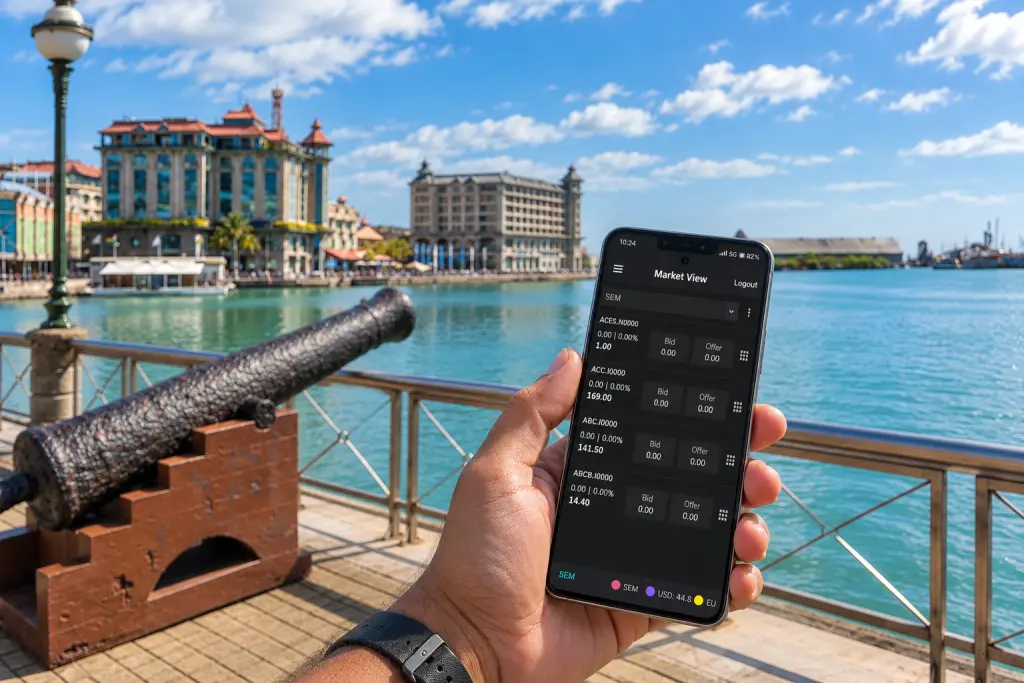
Yes. The Stock Exchange of Mauritius operates an online platform called mySEM, which lets registered investors follow the market, view listed securities, monitor CDS account activity and send orders through their broker. It works as a Progressive Web App, so you can access it through a compatible browser on your phone, tablet or computer. Having access to mySEM doesn’t remove the need for a stockbroker, though. Your licensed dealer must arrange your registration and trading credentials.
Step 3: Fund your account and decide how much to invest
The amount you need depends on the shares you want to buy, the number of shares and the applicable transaction charges. According to the SEM’s investor education guidance, there is no exchange-wide minimum investment amount, and the Odd Lot Board allows investors to buy as little as one share. That doesn’t mean you can always buy a share for just its quoted price. You’ll still need an available seller, an order that can be matched and enough money to cover trading charges. Your broker may also have additional operational requirements.
There isn’t one correct starting amount. Investing Rs 1,000 is quite different from investing Rs 50,000, particularly when it comes to diversification and transaction costs. For example, if you buy shares worth Rs 10,000 and pay the published maximum 1.25% equity transaction fee, the fee would be Rs 125, bringing the total purchase cost to Rs 10,125. What matters more than the amount is whether you can afford to leave the money invested. Buying shares with money needed for rent, school fees or emergencies creates a risk of having to sell at an unfavourable price.
Before deciding how much to invest, it helps to understand your monthly spending. Our cost of living in Mauritius guide covers common household expenses, while our living cost calculator can help you estimate your monthly budget.
Step 4: Buy your first shares
After your account has been approved, you can instruct your broker to purchase shares. Depending on the services offered, this may be done online through mySEM or by contacting the brokerage directly. Before placing an order, you’ll need to decide which security you want, how many shares to buy and the price you’re prepared to pay. A market order asks for execution against the best available prices under the exchange’s rules, but it doesn’t guarantee the last quoted price. A limit order lets you specify the maximum price you’re willing to pay when buying, or the minimum price you’ll accept when selling.
For example, suppose a share last traded at Rs 100, but you’re only willing to pay Rs 101. You could submit a limit buy order at Rs 101, which would execute only if a matching seller is available at an acceptable price. The order might remain unmatched, and that’s normal. In a relatively small market, there may be periods when nobody is willing to buy or sell at your chosen price.
Main Board vs Odd Lot Board
The SEM has different trading boards for standard equity lots and smaller quantities. The Main Equity Board generally handles standard lots in multiples of 100 shares, while the Odd Lot Board allows trading between 1 and 99 shares. If you only want 10 shares in a company, for example, the Odd Lot Board is the relevant facility. Odd Lot orders follow their own procedures, including the use of limit orders, and your broker can explain how to place them correctly.
| Trading board | Share quantity |
|---|---|
| Main Equity Board | Usually multiples of 100 shares |
| Odd Lot Board | 1 to 99 shares |
When your order matches an available buy or sell order, the trade is executed. Your broker then provides a contract note showing the security, quantity, execution price and applicable charges. Keep a copy of every contract note as a record of your investment and its cost.
Step 5: Understand settlement and dividends
Buying shares and settling the transaction are two separate stages. The Stock Exchange of Mauritius uses a T+3 settlement cycle, meaning settlement is scheduled for the third business day after the trade. If you buy shares on a Monday and there are no intervening market holidays, the normal settlement day would be Thursday. Similarly, when you sell shares, the payment is settled through the relevant process on T+3, with your broker explaining when the proceeds become available. The CDS uses a delivery-versus-payment settlement mechanism to coordinate the transfer of securities and funds, although this doesn’t protect an investor from market losses.
Some listed companies also pay dividends, which are distributions to shareholders. The amount and timing depend on the company’s financial performance and decisions, so payments are never guaranteed. When a dividend is declared, eligibility depends on the relevant record date and other corporate action arrangements, with payments generally processed through the company’s share registry using registered payment instructions. Keep your contact and banking details up to date with your broker and the registry. You can read the SEM’s clearing and settlement guidance for more details.
Stock Exchange of Mauritius trading fees
Trading fees are an important part of investing because transaction charges generally apply when buying and again when selling shares. For equity transactions, the SEM publishes a fee structure that includes amounts apportioned to the investment dealer, the Stock Exchange, the Financial Services Commission and the Central Depository. The published rates depend on the value of the transaction, with smaller trades generally attracting a higher percentage charge.
| Equity transaction value | Published total fee |
|---|---|
| Up to Rs 3 million | 1.25% |
| Above Rs 3 million to Rs 6 million | 1.15% |
| Above Rs 6 million to Rs 10 million | 1.05% |
| Above Rs 10 million | 0.90% |
For the smallest transaction category, the published 1.25% total is broken down into 0.75% for the investment dealer, 0.25% for the exchange, 0.05% for the regulator and 0.20% for CDS. Exchange-traded funds and debt securities have separate published arrangements, so don’t assume that the ordinary share fee applies to every listed product.
Example: Buying Rs 10,000 worth of shares
Suppose you purchase Rs 10,000 worth of shares and the full published 1.25% fee applies. Your buying fee would be Rs 125, bringing your total cost to Rs 10,125. If you later sold those shares for exactly Rs 10,000 and again paid 1.25%, you’d receive Rs 9,875 after the selling fee. Even though the share price hasn’t changed, the combined buying and selling fees would cost Rs 250. This is why frequent trading or making very small investments can become relatively expensive.
| Share purchase value | Rs 10,000 |
| Buying fee at 1.25% | Rs 125 |
| Total purchase cost | Rs 10,125 |
| Proceeds if later sold for Rs 10,000 | Rs 9,875 after the 1.25% selling fee |
The actual cost can depend on the security and broker arrangements, so always request a complete fee schedule before placing your first order. You can also consult the official SEM transaction fees.
Which shares and investments can you buy?
The Stock Exchange of Mauritius includes several types of listed securities. For most first-time investors, ordinary company shares are the easiest to understand, but there are also exchange-traded funds, bonds and foreign-currency securities. Each has a different investment purpose and risk profile, so it’s important to understand what you’re buying rather than treating every listed product as an ordinary share.
Shares in Mauritian companies
When you buy ordinary shares, you’re purchasing a small ownership interest in a company. If the business performs well, its share price may rise or it may distribute dividends. Poor performance, economic conditions or a lack of buyers can reduce the value of your investment. Examples of businesses represented in the SEM-10 index for the quarter beginning 7 October 2026 include MCB Group, SBM Holdings, IBL, CIEL, Vivo Energy Mauritius, Phoenix Beverages and Emtel. These are examples of listed companies, not recommendations to buy them. Index membership changes over time, so check the official SEM-10 constituents for the latest list.
Exchange-traded funds (ETFs)
An exchange-traded fund is an investment product traded on an exchange that tracks a particular asset, index or investment strategy. It can offer a different type of exposure from buying shares in a single company. The SEM’s ETF market includes products such as the ADBF ETF, denominated in US dollars, and the NewGold ETF, denominated in Mauritian rupees. Don’t confuse the SEM-10 index with an ETF: the SEM-10 is an index measuring selected companies, not a product you can automatically purchase. Before investing in an ETF, check its underlying assets, currency, expenses, liquidity and trading price relative to its net asset value. Current listings are available on the SEM ETF page.
Bonds and foreign-currency securities
The SEM also facilitates trading in certain bonds and other debt instruments. These generally involve lending money to an issuer in return for agreed interest payments and repayment terms. Their risks differ from those of shares, but they aren’t risk-free: bond prices can change with interest rates, issuers can fail to make payments and some securities may be difficult to sell before maturity. Certain SEM-listed investments are also denominated in USD, EUR, GBP or ZAR. This can be useful for some investors, but exchange-rate movements may affect the value when converted back into Mauritian rupees. Always check the currency and settlement arrangements for the specific investment.
Can foreigners invest in Mauritian shares?
Yes. The Stock Exchange of Mauritius allows foreign investors to participate in the market, subject to applicable restrictions and the compliance requirements of licensed intermediaries. The SEM states that foreign investors generally don’t need special approval to trade ordinary listed shares, although specific rules apply to certain investments, including aggregate foreign holdings in Mauritian sugar companies. Under the relevant restrictions, prior regulatory consent may be required where an investment would cause foreign investors collectively to hold 15% or more of the voting capital of a Mauritian sugar company, subject to specified exceptions. This isn’t simply a rule concerning one foreign investor personally acquiring 15%.
Foreign investors may also be able to repatriate investment proceeds, subject to banking, compliance and any applicable foreign exchange or tax rules in the relevant jurisdictions. If you’re a non-resident, contact a licensed stockbroker before attempting to open an account and ask about identification requirements, banking arrangements, foreign-currency transfers and tax-residency documentation. The SEM investor education FAQs provide further guidance.
What should you check before investing?
Opening the account is the administrative part. Deciding which investments are suitable is usually much harder. I’d be cautious about buying a share simply because the company has a familiar name, its price has fallen recently or somebody mentioned that it pays a good dividend. Take some time to understand how the company makes money, read its latest financial reports and consider whether the investment makes sense for your circumstances.
Understand the company’s financial performance
Look at revenue, profits, debt, cash flow and the risks management discusses in the annual report. For a hotel group, tourism demand and operating costs may be important. For a bank, lending performance, credit quality and interest margins matter. Different industries require different kinds of analysis, and a well-known brand isn’t necessarily an attractively priced investment.
Don’t focus only on dividend yield
A company with a high dividend yield may seem attractive, but the yield can rise simply because the share price has fallen. Consider whether the business generates enough cash to support its distributions and whether the dividend history is consistent with the company’s financial performance. A high historical yield isn’t a promise of future payments.
Check how easily you can sell
Some securities on a smaller exchange don’t trade frequently, which means you may be able to purchase shares but struggle to sell them quickly at the price you want. Check recent trading volumes, available buying and selling quotes, and the spread between them. A wide bid-ask spread can add to your effective transaction cost, particularly if you need to sell in a hurry.
Diversify and consider your time horizon
Concentrating all your money in one company exposes you to business-specific risks. Spreading investments across different companies and asset types may help reduce concentration, although it doesn’t eliminate the possibility of losses. Also remember that several Mauritian companies may be exposed to the same economic conditions, so owning multiple local shares doesn’t automatically provide broad international diversification. If you may need your money soon, accessible savings could be more appropriate than an investment that can fall in value or take time to sell.
Frequently asked questions
How do I buy shares in Mauritius? Choose a licensed stockbroker, open a CDS securities account, complete the required KYC documentation and place a buy order through the broker. You’ll receive a trade confirmation when the order is executed.
Which stockbrokers operate in Mauritius? The SEM’s August 2026 list includes AXYS Stockbroking, DMH Stockbroking, KICK Capital Markets, MCB Securities, SBM Capital Markets and Swan CMB Securities. Check the official broker directory for changes.
What is the minimum amount needed to invest in the SEM? The exchange doesn’t impose a universal minimum for ordinary share investing. Its Odd Lot Board allows trading from one share, subject to a matching order and broker requirements. Fees can make very small transactions less economical.
Can I buy MCB shares in Mauritius? Yes. MCB Group is listed on the Stock Exchange of Mauritius. You can submit an order through a licensed broker, provided the shares are available and the order meets the applicable trading conditions.
Can I trade through the mySEM app? Yes. The mySEM platform supports online market monitoring and order placement through participating licensed brokers. You must first open a CDS account and have your broker arrange access.
How much does it cost to buy Rs 10,000 worth of shares? At the published 1.25% maximum equity transaction fee for trades up to Rs 3 million, the fee would be Rs 125 on a Rs 10,000 transaction, making the illustrative purchase total Rs 10,125. Confirm actual charges with your broker.
How long does it take to receive money after selling shares? Trades normally settle on T+3, meaning three business days after the transaction. Your broker can explain the payment arrangements and when funds become available.
Are dividends taxed in Mauritius? Dividends paid by a Mauritius-resident company are generally exempt from Mauritian personal income tax under the MRA’s published rules. Other types of dividend income and foreign tax obligations may be treated differently.
Can non-residents invest in the Stock Exchange of Mauritius? Generally yes, subject to regulatory restrictions and the requirements of licensed stockbrokers. Non-residents should check the documentation, banking arrangements and any tax obligations in their country of residence.
If you’re considering your first investment, I’d begin by contacting a couple of licensed stockbrokers rather than trying to choose a share immediately. Ask for their account-opening requirements, complete fee schedule and online trading options. Once you understand those basics, you’ll be better placed to research individual companies and decide whether investing on the SEM fits your financial plans.
Official resources
- Stock Exchange of Mauritius – Market announcements, listed securities and company reports
- SEM licensed stockbrokers – Current investment dealer directory
- SEM transaction fees – Published trading charges
- SEM investor education courses – Learning materials for beginners
- Financial Services Commission – Financial services regulation and licensed entities
- Mauritius Revenue Authority – Tax-exempt income guidance




Questions and tips