
How to Register a Company in Mauritius (2026): Costs & Steps

Opening a company in Mauritius can be surprisingly straightforward if you’re setting up an ordinary local business. The official government incorporation fee for a domestic company is currently nil, and the Registrar of Companies says a compliant application can be processed within half a working day.
Things are quite different if you’re a foreign investor looking to establish a holding company, international consultancy or business operating across several countries. In that case, you may need a Global Business Licence, a licensed management company, local directors and a considerably larger budget.
This distinction is worth understanding before you pay anyone to register a company. A Mauritian resident opening a small marketing agency doesn’t have the same requirements as an international investor structuring investments into Africa.
There’s also plenty of confusing information online about Mauritius company tax. You’ll often see references to a 15% corporate tax rate, a 3% effective rate or even tax-free offshore companies. All three can describe different situations, but none is a universal tax rate for every business registered in Mauritius.
This guide explains how to open a company in Mauritius in 2026, the government fees you’ll actually encounter, the different company structures and what happens after incorporation. I’ve used the published guidance from the Corporate and Business Registration Department (CBRD), Financial Services Commission (FSC), Mauritius Revenue Authority (MRA) and Economic Development Board (EDB) wherever possible.
Important: This article provides general business information, not legal, tax or investment advice. The correct structure and tax treatment depend on your ownership, residence, activities and where your company is actually managed. Confirm your position with a qualified Mauritian professional before incorporating.
Company registration in Mauritius: Quick answers
| Question | 2026 answer |
|---|---|
| Can foreigners own a Mauritian company? | Yes, subject to rules for the business activity, ownership and management. |
| Domestic company incorporation fee | Rs 0 in government incorporation fees. |
| Annual registration fee for a small private company | Rs 500 if turnover does not exceed Rs 30 million, when paid on time. |
| Domestic company director requirement | Generally at least one director resident in Mauritius, with specific rules for foreign investors. |
| Standard corporate income tax | 15%, with separate rates or reliefs for certain activities and income. |
| Standard VAT rate | 15%. |
| General compulsory VAT registration threshold | Taxable turnover exceeding or expected to exceed Rs 3 million, subject to other compulsory-registration rules. |
| Time for straightforward domestic incorporation | The CBRD indicates around half a working day once a compliant application is received. |
| Does every business need a management company? | No. A licensed management company or registered agent is required for certain international structures, not every domestic company. |
The official figures come from the CBRD incorporation guidance, its 2026 annual registration fee schedule and the MRA’s current VAT registration guidance.
One important point: an incorporation fee of zero doesn’t mean you can operate a business without spending anything. You may still need to pay annual registration fees, business premises costs, local authority fees, professional fees, insurance or sector-specific licence charges.

Can foreigners open a company in Mauritius?
Yes. Foreign investors can establish and own companies in Mauritius, although the rules depend on the nature of the business, its ownership structure and whether the founder intends to live and work on the island.
For many ordinary business activities, full foreign ownership is possible. However, you shouldn’t assume that every regulated sector is open on identical terms. Activities such as certain financial services, property-related operations and other licensed businesses may have additional requirements.
A domestic company generally needs at least one resident director. The CBRD provides separate documentation requirements for situations involving foreign investors and permit holders, so it is worth confirming the relevant route before appointing directors or submitting an application.
There’s also a distinction between owning a company and having permission to live and work in Mauritius.
You may be allowed to hold shares in a Mauritian company without becoming a resident. But if you intend to move to Mauritius and actively manage the business from the island, you may need an Occupation Permit or another appropriate immigration authorisation.
The Economic Development Board published updated Occupation Permit guidance in August 2026. Under the revised Investor category, it states a minimum initial investment of USD 100,000, with turnover requirements for future renewal. These are immigration-related requirements, not the minimum amount that every Mauritian company must invest to be incorporated.
Check the Economic Development Board’s permit updates and our separate Mauritius Occupation Permit guide if you intend to relocate.
Which type of company should you register?
Before you start filling in application forms, decide where your business will operate and how it will earn money.
For someone opening a local shop, consultancy or service business, a domestic company will often be the first structure to consider. A Global Business Company or Authorised Company is generally more relevant when the activity and management arrangements are international.
| Structure | Typical purpose | Regulatory position |
|---|---|---|
| Domestic Company | Operating a local business in Mauritius | Incorporated with the Registrar of Companies; additional licences depend on the activity |
| Global Business Company (GBC) | International business or investments managed with sufficient Mauritius substance | Requires a Global Business Licence from the FSC and a licensed management company |
| Authorised Company | Qualifying overseas business or asset-holding activities with management and control outside Mauritius | Requires FSC authorisation and a registered agent |
1. Domestic Company
A domestic company is usually the most relevant option for someone starting a business that will operate primarily in Mauritius. Examples include a web design agency serving Mauritian clients, a retail shop, a local wholesaler, a restaurant or a small consulting firm.
Domestic companies are incorporated under the Companies Act 2001 through the Corporate and Business Registration Department. They need a registered office, directors, shareholders and the appropriate business registration information.
A standard domestic private company doesn’t automatically require an FSC-licensed management company, and the official incorporation fee is currently nil. This is the structure I would investigate first if the business will genuinely operate in Mauritius.
Depending on the activity, an ordinary domestic business may also be able to operate under another business form, such as a sole proprietorship, instead of incorporating a company. The right choice depends on liability, ownership, tax and reporting considerations.
2. Global Business Company (GBC)
A Global Business Company is intended for qualifying international business activities. The company is incorporated in Mauritius, holds a Global Business Licence issued by the Financial Services Commission, and is expected to maintain genuine management and economic substance in the country.
The current CBRD guidance requires a GBC to have at least two resident directors and to be administered by a licensed management company. It must also maintain its principal bank account in Mauritius and satisfy other regulatory obligations. GBCs are commonly considered for international investment, holding structures, cross-border operations and certain regulated financial activities.
Mauritius has a network of Double Taxation Avoidance Agreements, which can be useful for some international investments. However, treaty benefits aren’t automatic simply because you have a company registered on the island.
The company must satisfy the relevant residence and treaty conditions. Where required, it must also obtain a Tax Residence Certificate from the Mauritius Revenue Authority, and the other country may apply its own anti-avoidance or treaty eligibility rules.
A GBC is also subject to Mauritian corporate taxation. The much-discussed effective 3% rate applies only to qualifying income where the applicable partial exemption and substance conditions are met.
The Financial Services Commission’s Global Business guidance is the best starting point if this structure interests you.
3. Authorised Company
An Authorised Company is another international structure, but it is different from a GBC in an important way: its central management and control must be outside Mauritius.
It is generally treated as non-resident for Mauritian tax purposes when the applicable conditions are satisfied. That can mean foreign-source income is outside the Mauritian income tax charge, although tax obligations may arise in other countries. An Authorised Company is not entitled to Mauritian tax treaty benefits on the same basis as a qualifying Mauritian tax-resident company.
It must have a registered agent in Mauritius, and the FSC supervises its authorisation. It is not a suitable shortcut for somebody who actually intends to manage and control the business from Mauritius while claiming it is managed overseas.
The official comparison is available on the CBRD’s GBC and Authorised Company page.
How much does it cost to register a company in Mauritius?
This is where many online company formation guides become misleading. There’s a big difference between the government’s charge for incorporation and the full cost of establishing and maintaining a company.
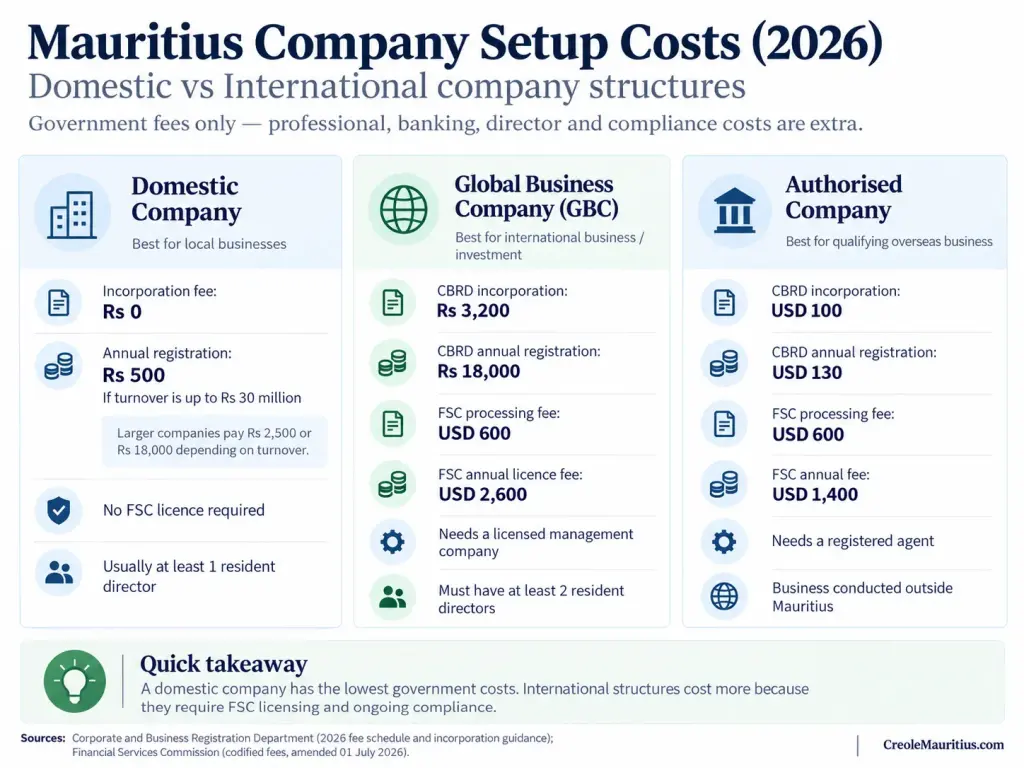
For a small domestic company, the direct government costs can be modest. For a GBC, the FSC licence fees, company administration, directors, accounting, audit and compliance services can add up quickly.
Domestic company fees in 2026
According to the Corporate and Business Registration Department, there is currently no government incorporation fee for an ordinary domestic private company. However, the company may still be required to pay an annual registration fee. The official 2026 schedule lists the following amounts when paid within the prescribed deadline:
| Private company category | 2026 annual registration fee |
|---|---|
| Turnover not exceeding Rs 30 million | Rs 500 |
| Turnover exceeding Rs 30 million but below Rs 100 million | Rs 2,500 |
| Turnover exceeding Rs 100 million | Rs 18,000 |
For example, someone registering a small local consultancy with turnover below Rs 30 million would not face a government incorporation fee and would fall into the Rs 500 annual registration category, assuming the published criteria apply. That doesn’t include any accountant’s fees, office costs, business permits or sector-specific licences. Some businesses will also need to register for VAT.
See the official 2026 company registration fee schedule.
Global Business Company fees in 2026
A GBC has two separate sets of government charges: registration fees payable to the Registrar of Companies and licensing fees payable to the Financial Services Commission. The FSC’s consolidated fee schedule, amended as at 1 July 2026, specifies:
| GBC fee | Published amount |
|---|---|
| FSC application processing | USD 600 |
| FSC standard annual licence fee | USD 2,600 |
| CBRD annual registration fee, private GBC | Rs 18,000 |
| CBRD incorporation fee | Approximately Rs 3,000 to Rs 3,200 in published CBRD guidance; confirm the current amount before filing |
The CBRD’s current online overview and its earlier published incorporation guide show slightly different GBC incorporation amounts. I’ve therefore kept that item as a range rather than treating either figure as a guaranteed invoice. The FSC charges above come from its July 2026 licensing schedule.
One detail that can affect a first-year budget is that the FSC prorates its first annual licence fee according to the quarter in which the application is made. For example, the published first-year GBC fee for an application made between October and December is USD 1,950, rather than the full USD 2,600 annual amount.
These are only government charges. A GBC normally also needs a licensed management company, resident directors, corporate administration, accounting, auditing and other compliance services. Those professional fees vary enough that I wouldn’t trust a universal company formation quote advertised online. Ask several licensed management companies for itemised quotations covering both the first year and subsequent renewals.
Authorised Company fees in 2026
For an Authorised Company, the FSC’s July 2026 fee schedule lists a USD 600 application processing fee and a USD 1,400 standard annual fee.
The CBRD separately lists a USD 100 incorporation fee and a USD 130 annual registration fee for an Authorised Company in its published guidance and 2026 registration schedule. Like the GBC fee, the FSC’s first annual licence fee may be prorated according to the application period. A registered agent and ongoing administration will also involve professional fees that are not included in these government amounts.
The complete regulatory schedule is available through the FSC’s official list of licences and fees.
Don’t confuse professional quotes with government fees
If a company formation provider quotes you several thousand US dollars to establish a GBC, that doesn’t mean Mauritius charges several thousand dollars simply to issue a certificate of incorporation.
The provider’s quotation may include local directors, a registered office, regulatory applications, company secretarial work, compliance checks, accounting and assistance with opening a bank account. Ask which services are compulsory for your specific structure, which are optional, and which costs recur every year. A low initial quotation can become expensive if directors’ fees, audit fees or annual administration are excluded.
How to register a domestic company in Mauritius
For an ordinary domestic private company, the application is handled by the Corporate and Business Registration Department. The process can be completed online through the Mauritius Network Services portal, or through the Registrar’s office using the prescribed documentation.
Step 1: Decide on your company name and structure
Choose a name that is available and complies with the relevant naming rules. You’ll also need to decide who the shareholders and directors will be, how the shares will be allocated, and where the registered office will be located.
The registered office should be a genuine address that meets the legal requirements. If you’re using a residential address, rented property or a service provider’s office, make sure you are authorised to use it.
Step 2: Prepare the company information
The incorporation application includes details of the proposed company, directors, shareholders, registered office and business activities. You will also need the required consents and beneficial ownership information. If the company has a constitution, the appropriate document must be supplied as part of the application.
Step 3: Submit the application through the registration portal
The CBRD directs online applicants to the Mauritius Network Services portal. Follow the current company incorporation procedure, enter the required information and upload the supporting documents.
Make sure the names, identification details and shareholding information are consistent across the forms. Incorrect or missing information can delay an application that would otherwise be straightforward.
Step 4: Receive the certificate of incorporation
Once the application complies with the Companies Act requirements, the Registrar issues a Certificate of Incorporation and records the company in the register.
The registration process also provides for the business registration information and the electronic Business Registration Card. The company’s registration number identifies it in the official register.
Keep digital copies of the certificate, registration details and constitutional documents. You’ll need them for banking, tax registration and other administrative procedures.
Step 5: Complete the operating requirements
Receiving the incorporation certificate does not automatically authorise every type of commercial activity. Depending on the business, you may need local authority permissions, a trade fee arrangement, sector-specific licences, health or safety approvals, or other regulatory authorisations before starting operations.
A restaurant, for instance, has different operating considerations from a software consultancy working from an office. Check what applies to your proposed premises and activity before signing a long lease or buying expensive equipment.
The CBRD’s domestic incorporation page explains the forms and core registration requirements.
How to set up a Global Business Company or Authorised Company
International structures involve a different application process because the Financial Services Commission supervises the relevant licences and authorisations.
For a GBC, the application goes through an FSC-licensed management company. An Authorised Company similarly requires an appropriate registered agent.
- Choose the intended structure based on the actual business activities, ownership and management arrangements.
- Contact licensed management companies or registered agents and request quotations and eligibility assessments.
- Prepare identification, beneficial ownership, source-of-funds and business information required for due diligence.
- Arrange the appropriate directors, registered office, management and substance arrangements.
- Submit the incorporation and relevant FSC licensing or authorisation applications through the approved channels.
- Arrange corporate banking and any additional regulatory licences relevant to the business.
- Establish ongoing accounting, reporting, compliance and renewal procedures.
For a GBC, appointing resident directors merely to appear compliant on paper is not enough. The actual management arrangements, decision-making processes and economic substance need to meet the applicable requirements.
Before selecting a provider, check that it appears on the Financial Services Commission’s official licensing resources and ask who will be responsible for each annual filing.
I’d compare at least two or three detailed quotations. The cheapest provider isn’t necessarily the best choice if the ongoing administration, director services or banking support are important to your company.
Documents required for company registration
The documentation depends on whether you’re incorporating a normal domestic company or applying for a structure regulated by the FSC.
For a domestic company
The CBRD identifies the following among the required information and supporting documents:
- Proposed company name and registered office address
- Details of directors and shareholders
- Signed consent forms for the relevant officers and shareholders
- Proof of address and identification documents where required
- Beneficial ownership declarations and an ownership structure chart, if applicable
- Company constitution, where one is adopted
- Business activity and principal place of business information
Foreign applicants may be asked for additional immigration or identity documentation depending on their position and the company’s proposed management arrangements.
For a GBC or Authorised Company
International applications generally involve more detailed due diligence. Expect the management company or registered agent to request information such as:
- Passports and verified addresses for relevant shareholders, directors and ultimate beneficial owners
- Ownership and control structure details, particularly where companies or trusts appear in the structure
- Business plan and description of the intended activities
- Expected markets, counterparties, transaction types and funding arrangements
- Source-of-funds and source-of-wealth documentation
- Proposed directors, management arrangements and evidence relevant to the required substance
The exact checklist will depend on the structure and risk assessment. A regulated investment business will ordinarily require more extensive documentation than a straightforward non-regulated holding entity.
Corporate tax in Mauritius: What companies actually pay
Mauritius is often described as a low-tax jurisdiction, but the corporate tax rules need a little more explanation than a single headline percentage.
The standard 15% corporate tax rate
The standard corporate income tax rate in Mauritius is 15%. Companies engaged in qualifying exports of goods may be subject to a reduced 3% rate, while other specific activities and types of income have separate rules or exemptions.
A normal domestic company operating locally will generally start by considering the standard corporate tax rules, along with any applicable deductions, incentives or additional obligations.
When does the effective 3% rate apply?
You may have read that GBCs pay just 3% tax on foreign income. That description leaves out an important condition. Under the partial exemption regime, certain qualifying income can benefit from an 80% exemption, subject to statutory requirements. Examples listed in the MRA guidance include qualifying foreign dividends, certain interest income and profits attributable to a foreign permanent establishment, among other categories.
If income qualifies for an 80% exemption, the remaining 20% is subject to the applicable corporate tax calculation. At a 15% rate, that produces an effective 3% tax on that particular qualifying income before considering any separately applicable levies or adjustments.
The exemption depends on conditions relating to core income-generating activities, adequate personnel and expenditure in Mauritius. It doesn’t automatically apply to every overseas service invoice or to all revenue earned by a GBC. Check the current categories and requirements in the MRA’s corporate tax guidance before assuming your income qualifies.
Are Authorised Companies tax-free?
An Authorised Company is generally treated as non-resident for Mauritian income tax purposes where the applicable conditions are satisfied. Its foreign-source income may therefore fall outside Mauritius’ tax charge.
That should not be confused with an exemption from taxation everywhere. The country where the company is managed, where its customers or assets are located, or where its owners are resident may impose taxes or reporting obligations. If your intention is to run an international business from another country through a Mauritius-registered entity, obtain tax advice covering both jurisdictions before proceeding.
VAT registration in Mauritius
One recent change matters particularly to smaller businesses. From 1 October 2025, Mauritius reduced the general compulsory VAT registration threshold from Rs 6 million to Rs 3 million.
Businesses whose taxable turnover exceeds or is expected to exceed the prescribed threshold generally need to register for VAT. Certain specified businesses and professions must register regardless of turnover, so being below Rs 3 million does not automatically mean every business is exempt. The standard VAT rate is 15%, although exemptions and zero-rating rules apply to certain supplies.
The MRA’s simplified VAT registration page explains the current registration arrangements and links to its online service.
Other corporate levies and contributions
Some larger companies may have additional obligations beyond ordinary income tax. These can include the Corporate Climate Responsibility Levy and, for qualifying businesses, the Fair Share Contribution introduced from July 2025.
The Fair Share Contribution includes specific profit thresholds, rates and exclusions. Global Business Licence holders are among the excluded categories under the published regime. The 2026/27 Budget also proposed changes to certain eligibility conditions, so larger businesses should check the enacted rules and current MRA guidance before calculating their liability.
This is one reason a simple comparison of countries using only headline corporate tax percentages can be misleading. The final amount depends on the company’s income, activity and eligibility for particular treatments. For updated information, use the Mauritius Revenue Authority and its Fair Share Contribution guidance.
What happens after your company is registered?
Incorporation is the beginning of running a business, not the end of the paperwork. Once the company has been registered, several other tasks may need attention.
Open a corporate bank account
Most operating businesses will need a bank account in the company’s name. Banks typically ask for incorporation documents, details of directors and beneficial owners, information about business activities and evidence explaining the expected source of funds. Some local companies may find banking arrangements relatively straightforward, while businesses with non-resident owners or complex international transactions can face additional compliance checks.
Bank account approval is separate from company incorporation. A newly issued Certificate of Incorporation does not guarantee that a particular bank will accept the application. Our guide to opening a bank account in Mauritius focuses mainly on personal and expat banking, but it provides useful background on local banks and the documentation they request. Corporate requirements should be confirmed with each bank’s business banking department.
Set up your tax and accounting arrangements
Companies need to maintain accounting records and meet their applicable tax and reporting obligations. Depending on the company, these may include annual income tax returns, VAT filings, payroll reporting and other statutory submissions.
It’s worth speaking to an accountant early, especially if your company will have employees, imported goods, foreign-currency income or international shareholders.
Maintain company records and annual filings
Companies must maintain accurate information about their directors, shareholders, beneficial owners and registered office. Changes may need to be reported to the Registrar within the applicable deadlines.
Annual registration fees and statutory filing obligations also continue after incorporation. A GBC or Authorised Company must additionally comply with its FSC licensing or authorisation conditions and renewals.
Register as an employer if you hire staff
If the company employs people in Mauritius, you’ll need to comply with applicable employment, payroll, social contribution and labour requirements.
Foreign directors and employees must also have the appropriate immigration or work authorisation for their activities. Owning shares in the company doesn’t by itself give a foreign national permission to work locally. For related information, see our guide to working in Mauritius.
How long does company registration take?
The CBRD’s published incorporation guidelines state that a company can be incorporated within around half a working day once a compliant application has been submitted. That is the Registrar’s processing timeframe for straightforward incorporation, not a guarantee that every new business will be ready to operate that afternoon.
Opening a bank account, obtaining sector-specific permissions, securing suitable premises and completing any immigration formalities are separate matters. A GBC or Authorised Company can take longer because the FSC must assess the application and the relevant management company or registered agent needs to complete due diligence and documentation.
Rather than promise a fixed number of weeks for international structures, I would ask the service provider for separate estimated dates for incorporation, FSC approval, bank account opening and operational readiness. These stages can move at different speeds. The official CBRD incorporation guidelines explain the standard registration process and its stated processing time.
Frequently asked questions
How much does it cost to open a small company in Mauritius?
The government currently charges no incorporation fee for an ordinary domestic private company. Its annual registration fee is Rs 500 if turnover does not exceed Rs 30 million and the fee is paid on time. Other operating, professional and licensing costs may still apply.
Can a foreigner own 100% of a company in Mauritius?
Full foreign ownership is possible for many business activities, subject to applicable sector restrictions, management requirements and any additional approvals. Foreign ownership and the right to live or work in Mauritius are separate matters.
Do I need a Mauritian partner to register a company?
Not necessarily. Many companies can be foreign-owned without a local shareholder. However, domestic companies generally require a resident director, and regulated activities may have additional conditions.
How long does it take to register a company in Mauritius?
For a straightforward domestic company, the Registrar indicates that compliant applications can be processed in around half a working day. FSC licensing, banking, operating permits and other approvals can take longer.
Is Mauritius a tax-free country for companies?
No. The standard corporate income tax rate is 15%. Different rates, partial exemptions and non-resident tax rules apply in specific circumstances, but there is no universal tax-free status for every company registered in Mauritius.
Can I open a company without living in Mauritius?
It may be possible, depending on the structure and arrangements for directors, management and regulatory compliance. A GBC generally requires substantial Mauritian management and oversight, while an Authorised Company has different rules requiring central management and control outside Mauritius.
Do all companies need to register for VAT?
No. The general compulsory VAT threshold is taxable turnover exceeding or expected to exceed Rs 3 million. However, specified professions and activities may require registration irrespective of turnover.
What is the difference between registering a business and incorporating a company?
Business registration can apply to different forms of business activity, including businesses operated by individuals. Incorporating a company creates a separate legal entity under the Companies Act. The ownership, liability, accounting and filing implications can differ.
Can I get a Mauritius Occupation Permit by opening a company?
Company incorporation alone does not grant an Occupation Permit. Foreign investors must satisfy the applicable immigration criteria, including any investment and ongoing business performance requirements.
Which government websites should I use?
The Corporate and Business Registration Department handles company incorporation and registration. The Financial Services Commission regulates relevant financial services and global business licences. The Mauritius Revenue Authority handles taxation, while the Economic Development Board provides information for investors and foreign nationals applying for qualifying permits.
For a small business operating locally, I’d begin with the CBRD’s domestic incorporation process. International investors should first establish which licence and tax treatment genuinely fit their activities, then obtain a detailed quotation from a licensed service provider. Sorting that out before registration can prevent expensive restructuring later.




Questions and tips