We all dream of that moment where we are sipping a coconut on the beach, staring at the turquoise lagoon, and knowing that our money is busy making more money for us. While we can’t promise you a Leonardo DiCaprio lifestyle (and hopefully not the legal troubles that come with it), investing in the Stock Exchange of Mauritius (SEM) is a fantastic way to build wealth while you enjoy the island life.
At Creole Mauritius, we are big fans of financial freedom. Whether you are saving up to cover the cost of living in Mauritius or just want enough extra cash to upgrade your car using our guide on buying and registering a car in Mauritius, the stock market is a tool you should definitely explore.
But where do you start? Is it complicated? Do you need to wear a suit? (Spoiler: No, flip-flops are usually fine).
We have compiled the ultimate, foolproof guide on how to invest in the Stock Exchange of Mauritius. Grab a coffee, or perhaps something stronger, and let’s dive into the world of Mauritian finance.
Contents
What is the Stock Exchange of Mauritius (SEM)?
Before you start throwing your hard-earned rupees at the screen, it helps to know what you are actually dealing with. The SEM isn’t some dusty backroom operation. It is a modern, well-regulated, and surprisingly robust securities market.
Established way back in 1989 (when shoulder pads were big and internet was a sci-fi concept), the SEM has grown into a leading exchange in Africa. It lists over 180 securities across various asset classes. This means you are not just stuck buying shares in sugar companies, although you can do that too if you have a sweet tooth for history.
The exchange is split into two main VIP sections:
- The Official Market: This is for the big boys. The large, established companies that have been around for ages. Think major banks and hotel groups.
- The Development & Enterprise Market (DEM): This is for the smaller, growing companies. It is a bit riskier, but potentially more rewarding if you pick the next big thing.
Why Should You Care? (The Benefits)
You might be thinking, “Why bother? I’ll just keep my money under the mattress.” Well, besides the fact that mattresses are terrible savings accounts, the SEM offers some incredibly juicy benefits, especially if you are an expat or a foreign investor.
1. The Tax Sweetener
Here is the headline news: No Capital Gains Tax.
That is right. If you buy a share for Rs 100 and sell it for Rs 200, that Rs 100 profit is yours. The taxman does not take a cut.
Also, No Tax on Dividends. If a company pays you a share of their profits, it lands in your account tax-free.
2. Everyone is Welcome
Foreign investors drive about 40% of the daily trading activity. Why? Because Mauritius makes it easy. You don’t need special government approval to buy shares (unless you are planning to buy more than 15% of a sugar company, which is a very specific ambition). You can also repatriate your funds freely. So if you make a million, you can send it home without a hassle.
3. Currency Buffet
You are not limited to just Mauritian Rupees (MUR). The SEM supports trading in US Dollars (USD), Euros (EUR), British Pounds (GBP), and South African Rand (ZAR). This is great if you are earning in foreign currency or want to hedge your bets against exchange rate fluctuations.
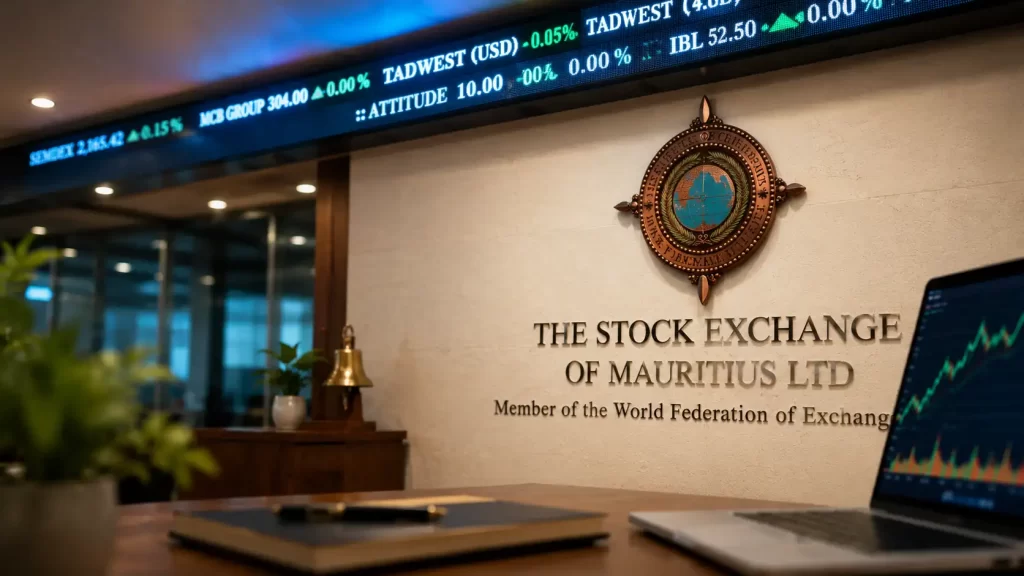
Step 1: Choosing Your Partner (The Broker)
You cannot just walk into the Stock Exchange building in Port Louis and shout “Buy!” like they do in the movies. You need a middleman, officially known as a Licensed Investment Dealer or stockbroker.
You need to open a Central Depository System (CDS) account. Think of this as your “stock wallet.”
There are nine licensed investment dealers in Mauritius. Here are the main players you can choose from:
- MCB Securities Ltd (Very popular, linked to the biggest bank).
- SBM Capital Markets Ltd (Linked to the State Bank).
- Swan Securities Ltd (Great if you like the Swan insurance brand).
- AXYS Stockbroking Ltd.
- Capital Markets Brokers Ltd.
Pro Tip: If you already bank with MCB or SBM, it is usually easiest to stick with their brokerage arm. It makes transferring money between your savings and your trading account seamless.
Step 2: The Paperwork (It’s Not That Bad)
Once you have picked your broker, you need to register. In the old days, this meant killing a small forest of trees for paper forms. Nowadays, it is much more streamlined, though you will still need to prove you exist.
You will typically need to provide:
- National ID Card or Passport (To prove you are you).
- Proof of Address (A utility bill less than 3 months old). This is standard for everything in Mauritius, whether you are signing up for internet or enrolling your kids in one of the international schools in Mauritius.
- Bank Account Details (So they know where to send your millions).
The broker will run a “Know Your Customer” (KYC) check. They will ask some questions about your income and financial goals. Just be honest.
Once that is cleared, you get your shiny new CDS account number and login details for the trading platform. Most brokers now offer mobile apps, like the mySEM app, so you can trade while waiting in line for dholl puri.
Step 3: Show Me The Money (Funding)
You have the account. Now you need the cash.
You can fund your brokerage account via:
- Bank Transfer: The most common method.
- Cheque: If you are feeling retro.
- Cash: Possible, but subject to strict limits because of anti-money laundering rules.
The Golden Rule: There is no minimum investment.
Read that again. You can buy literally one share if you want. If a share costs Rs 50, you can start investing with Rs 50. This makes the SEM incredibly accessible. You don’t need to be a millionaire to start; you just need to be willing to start.
Step 4: Placing Your First Trade
This is the exciting part. You have logged in, you see the numbers flashing (or static, depending on how exciting the day is), and you are ready to buy.
You can place orders via:
- The Online Platform/App: The DIY approach. You click buy, you set the price, you wait.
- Email or Phone: You can call your broker and say, “Buy me 100 shares of MCB.” They will execute it for you.
Understanding the Boards
The SEM has a unique system to help everyone trade, regardless of budget.
- The Main Board: This is for standard trading lots, usually in multiples of 100 shares.
- The Odd Lot Board: This is the hero for small investors. It allows you to trade between 1 and 99 shares. So if you only have budget for 10 shares, you trade here.
The Price Rule
To prevent the market from going crazy, orders usually have to be within a certain range of the current market price (typically 20% above or below). You can’t put in a buy order for Rs 1 if the share is trading at Rs 100.
Step 5: The Waiting Game (Settlement)
You clicked buy. Now what?
Trades on the SEM settle on a T+3 basis.
- T = Transaction Day (Today).
- +3 = Three business days later.
If you buy shares on Monday, the money will leave your account and the shares will officially be yours on Thursday.
If you sell shares on Monday, you get your cash on Thursday.
This is important to remember if you need liquid cash urgently. Don’t sell your shares thinking you can pay your rent tomorrow. Speaking of rent, if you are looking for a place to stay while you build your empire, check our guide on Mauritius rent prices in 2025.
The Cost of Doing Business (Fees)
Nothing in life is free, and trading is no exception. However, the fees on the SEM are regulated and relatively reasonable.
The fees are a percentage of your transaction value. This fee is split between the broker, the SEM, the regulator (FSC), and the Central Depository (CDS).
Here is the typical breakdown:
| Transaction Value | Total Fee (Approx) |
| Up to Rs 3 Million | 1.25% |
| Rs 3M to Rs 6M | 1.15% |
| Rs 6M to Rs 10M | 1.05% |
| Over Rs 10M | 0.90% |
So, if you invest Rs 10,000, you will pay about Rs 125 in fees. That is less than the price of a fancy coffee. It is a small price to pay for owning a piece of a company.
What Can You Actually Buy?
It is not just about buying banks and hotels. The SEM has diversified a lot.
- Ordinary Shares: Ownership in companies.
- ETFs (Exchange Traded Funds): These are baskets of shares. For example, you can buy an ETF that tracks the top 10 companies on the SEM (SEM-10). It is instant diversification.
- Bonds: If you want steady interest payments rather than fluctuating share prices.
- Foreign Funds: There are listings that give you exposure to African markets or even global tech companies.
Making a Strategy (Don’t Just Guess)
We are not financial advisors, and you should always do your own research. But here are a few tips for the Mauritian market:
- Look at Dividends: Many Mauritian companies pay healthy dividends. This is great for passive income.
- Think Long Term: The SEM is not usually a volatile casino. It is a steady builder of wealth. Patience is key.
- Diversify: Don’t put all your money in one sector. If tourism has a bad year, you don’t want your whole portfolio to tank.
Maybe your goal is to grow your wealth so you can eventually afford the Occupation Permit financial requirements, or perhaps you just want enough profit to treat yourself to a VIP table at one of the best nightclubs in Mauritius. Whatever your goal, having a plan helps.
Useful Resources
To keep track of your investments, you will want to bookmark these sites:
- The Stock Exchange of Mauritius Official Site (For daily data and annual reports).
- Financial Services Commission (The regulator who keeps everything safe).
Conclusion: Start Small, Dream Big
Investing in the Stock Exchange of Mauritius is one of the smartest moves you can make if you live here or have ties to the island. It is accessible, tax-efficient, and surprisingly simple once you get past the initial paperwork.
You don’t need to be a Wall Street shark. You just need to be a smart Mauritian (or expat) who knows that money sitting in a bank account is boring. Get it out there, let it work for you, and who knows? Maybe next year, your dividends will be paying for your beach holidays.
So, calculate your budget using our living cost calculator, see what you can spare, and make that first trade.
Disclaimer: We are not financial advisors. This blog is for educational and entertainment purposes only. Stocks can go down as well as up. Don’t invest money you need for next week’s groceries.