So, you have decided to pack up your life, grab your passport, and move to paradise. Mari top (super good) choice! You are picturing weekends at the beach and sunsets with a cocktail in hand. But then, reality hits you like a coconut falling from a tree. You have children. And those children need to go to school.
Suddenly, your relaxing island dream turns into a kas latet (headache) of spreadsheets, waiting lists, and currency conversions. Do not panic. The education landscape here is surprisingly robust. We have everything from prestigious institutions that feel like tropical Ivy Leagues to laid-back schools where the kids might just learn marine biology by looking out the window.
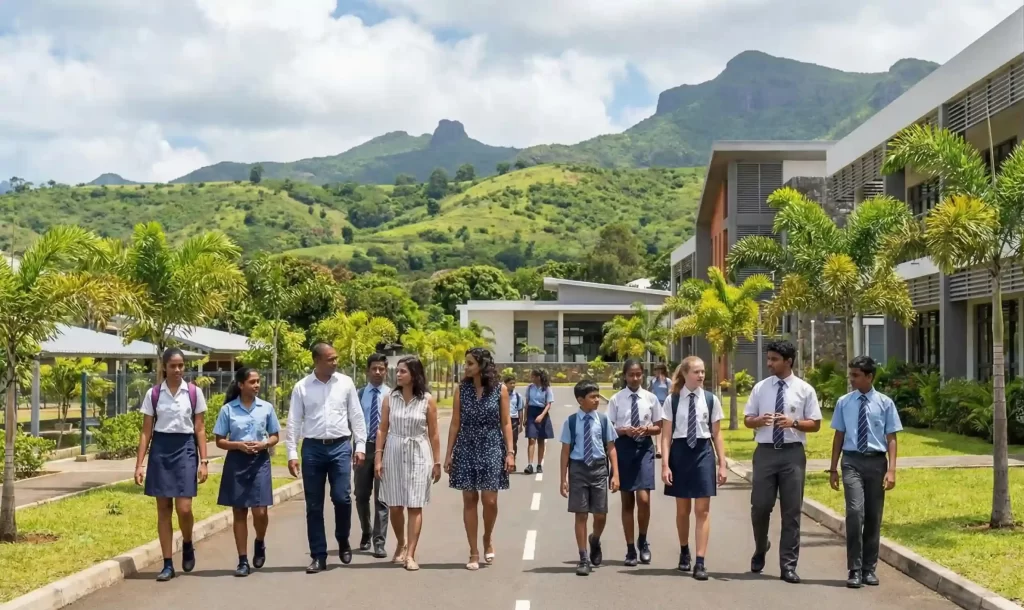
This guide is here to help you navigate the maze of international schools in Mauritius without losing your sanity or your entire bank account.
Contents
The Big Picture: The “Big 3” and Beyond
Mauritius hosts a thriving ecosystem of about 10 to 15 major international schools. These are English-medium schools designed specifically to cater to the transient (and permanent) expat population.
Locals often refer to the “Big 3” when talking about the heavy hitters: Northfields International School, Le Bocage International School, and West Coast International Secondary School. These guys are the rock stars of the education world here. They have the facilities, the reputation, and yes, the waiting lists to match.
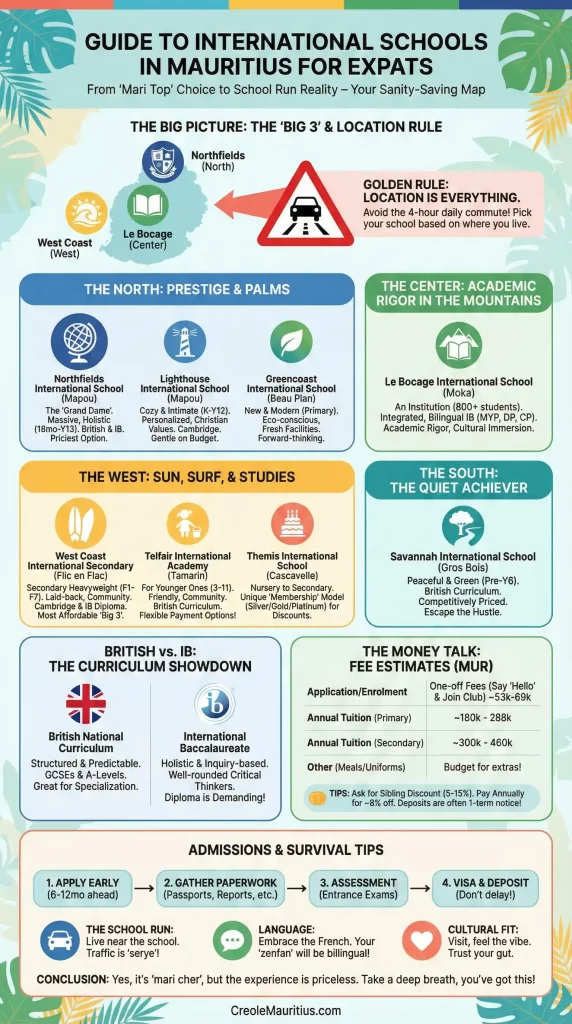
But before you start filling out forms, you need to understand one golden rule of living in Mauritius: Location is everything. You do not want to live in the south and send your kid to school in the north. The traffic here is serye (serious). Unless you want to spend four hours a day in your car, pick your school based on where you live, or pick where you live based on the school. If you are planning to drive, check our guide on buying and registering a car in Mauritius because the school run is a battlefield.
The North: Prestige and Palms
The North is where the highest concentration of expats live, so naturally, it is where you find the most schools.
Northfields International School (Mapou)
This is often considered the “Grand Dame” of international schools here. Established in 2001 and now part of the Inspired global group, it is massive. Northfields serves approximately 1,200 students, creating a bustling campus that feels like a small village. It is the most comprehensive option on the island, taking kids from the wobbly walking stage (18 months) all the way to university entrance (Year 13).
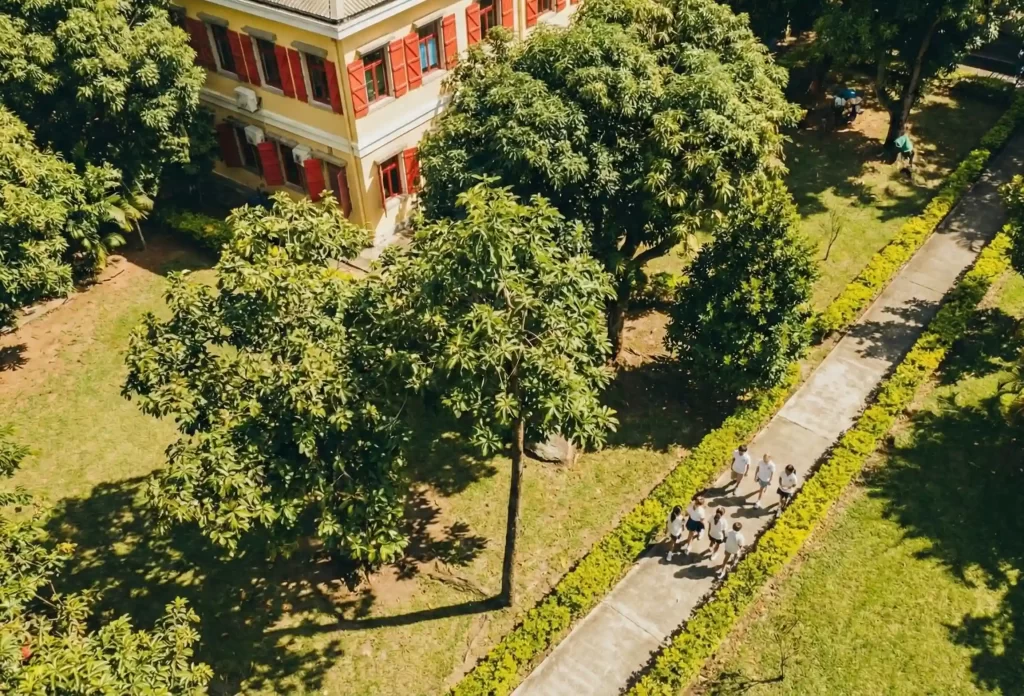
Because of its size and reputation, it attracts a majority expatriate population, making it the default landing zone for many English-speaking families arriving in Grand Baie.
- The Vibe: It feels very international. You will find a sea of diverse faces here. It is holistic, meaning they care about sports and arts just as much as algebra.
- Curriculum: They offer the English National Curriculum along with the International Baccalaureate (IB) PYP, MYP, and Diploma.
- The Cost: Hold onto your wallet. It is the priciest option. Primary fees hover around MUR 216,000 – 240,000 annually. There are also hefty enrolment fees and a deposit that could probably buy a small boat.
- Who is it for? Families who want a globally recognized brand and are likely living in Grand Baie or Pereybere.
Get Directions to Northfields International School
Lighthouse International School (Mapou)
Located just down the road from Northfields, Lighthouse offers a distinct alternative for families who find the “mega-school” atmosphere a bit overwhelming. It serves children from Kindergarten through Year 12 and prides itself on a more intimate environment. The school emphasizes personalized teaching approaches and Christian values, though it is open to all.
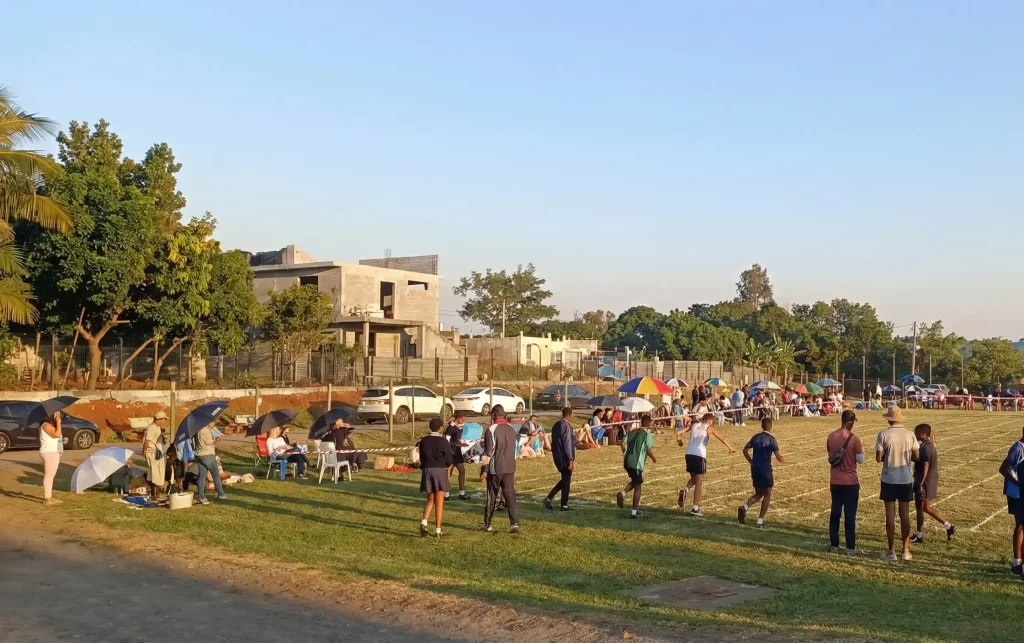
For families living in the north who want an English education without the sheer scale (and price tag) of its neighbor, Lighthouse is often the preferred choice.
- The Vibe: It is smaller, cozy, and focuses heavily on community and individual attention.
- Curriculum: Cambridge curriculum with IGCSEs and A-Levels.
- The Cost: Slightly more gentle on the budget, with primary fees between MUR 180,000 – 198,000 annually.
Greencoast International School (Beau Plan)
The new kid on the block, opened in January 2019, sits right in the heart of the Beau Plan Smart City. Greencoast was built with a modern philosophy in mind, catering to primary students through Year 6. Because the facilities are newer, everything feels fresh, and the location is incredibly convenient for parents working in the business parks nearby.
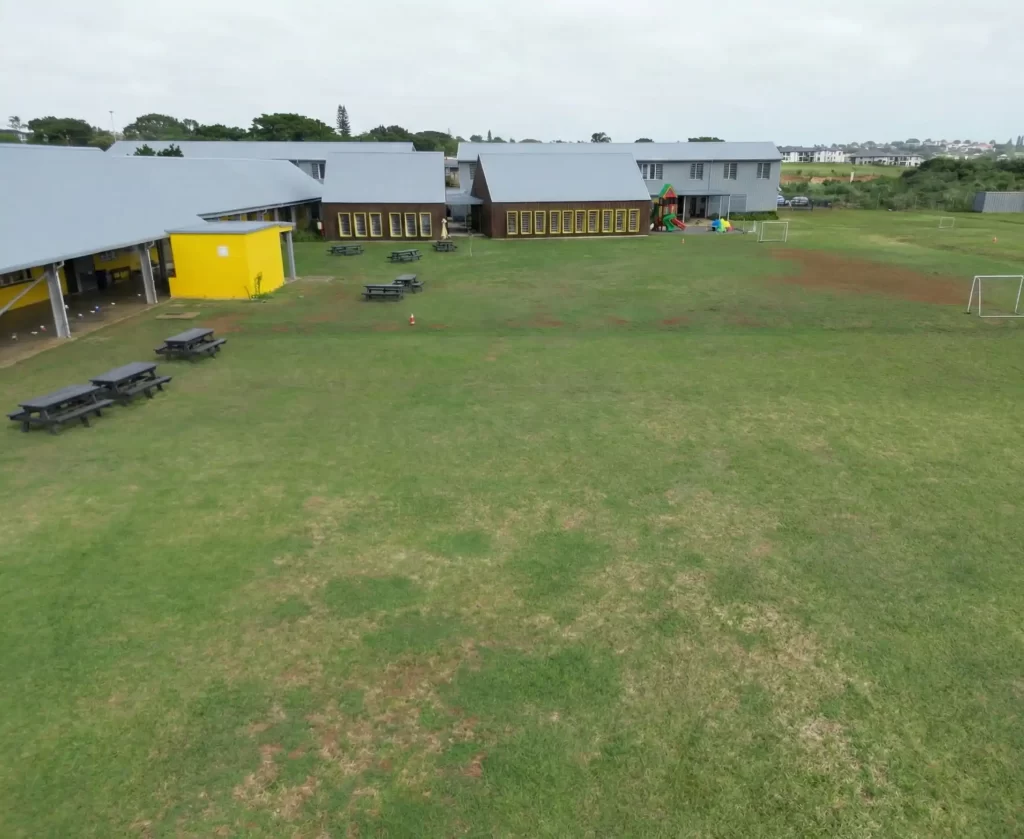
It is quickly gaining a reputation as a forward-thinking alternative to the traditional giants, appealing to parents who value sustainability and modern infrastructure.
- The Vibe: Modern, fresh, and eco-conscious. The facilities are shiny and new.
- Cost: Around MUR 288,000 annually for primary.
- Note: It is quickly becoming a strong rival to the established schools in the north.
The Center: Academic Rigor in the Mountains
Le Bocage International School (Moka)
Founded in 1990, Le Bocage is an absolute institution in Mauritius. Sitting in the cooler central plateau of Moka (you might actually need a sweater here in winter), it serves over 800 students. Unlike the northern schools which are heavily expat-dominated, Le Bocage has a strong mix of Mauritian nationals. This creates a much more integrated environment where your children will hear Creole and French spoken in the corridors, offering a genuine slice of island culture.
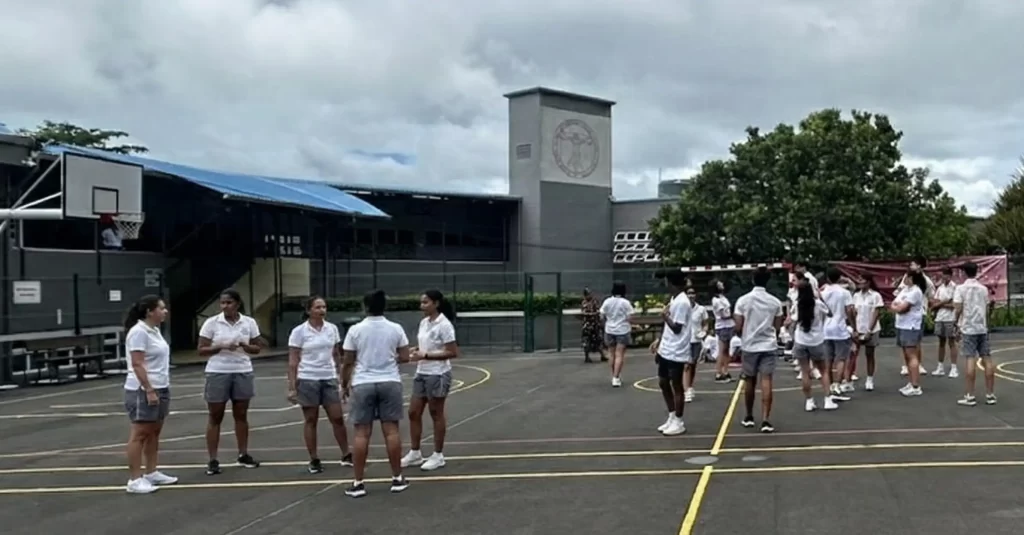
It is known for being academically rigorous and is the go-to spot for families who want their kids to be “street smart” locally as well as book smart.
- The Vibe: Genuine integration. It is the best place for cultural immersion while maintaining high international standards.
- Curriculum: Pure IB. They do the Middle Years Programme (MYP), Diploma Programme (DP), and Career-Related Programme (CP). It is bilingual, so expect your kids to get good at French.
- The Cost: It is an investment. Fees range from MUR 424,050 to MUR 464,200.
- Who is it for? Families who value academic rigor and want their kids to be part of the local fabric. It is very popular with the Indian and Indo-Mauritian expat communities.
Get Directions to Le Bocage International School
The West: Sun, Surf, and Studies
If you are living the digital nomad life in Mauritius around Tamarin or Flic en Flac, you are likely looking here.
West Coast International Secondary School (Flic en Flac)
This is the secondary heavyweight for the west coast, catering to students from Form 1 to Form 7. If you live in Tamarin or Flic en Flac, driving to the North or Center daily is a nightmare, making West Coast the logical (and sanity-saving) choice. It attracts a significant South African expatriate community, giving it a distinct, friendly atmosphere.
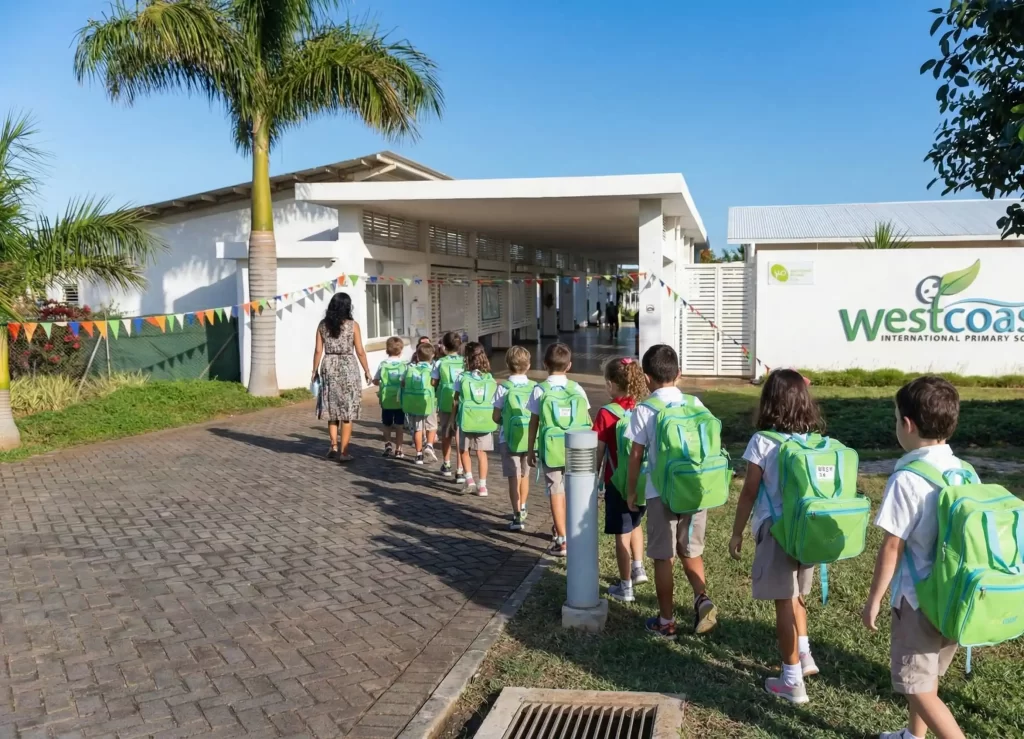
While some parents note it has a more relaxed approach compared to the academic pressure cookers of the center, it provides a solid international education at a very competitive price point.
- The Vibe: Laid-back, outdoorsy, and filled with a strong sense of community.
- Curriculum: Cambridge Lower Secondary, IGCSEs, and then the IB Diploma for the final years.
- The Cost: It is the most affordable of the “Big 3”, with tuition around MUR 294,000 for lower secondary.
- Note: It is the only real option for secondary international schooling in the immediate area, so book early.
Get Directions to West Coast International Secondary School
Telfair International Academy (Tamarin)
For the younger ones (ages 3-11), Telfair is a staple in the Tamarin community. It is the kind of school where parents know each other from the local surf spots or coffee shops. They distinguish themselves with very flexible payment options, monthly or termly, which is a huge relief for families managing cash flow.
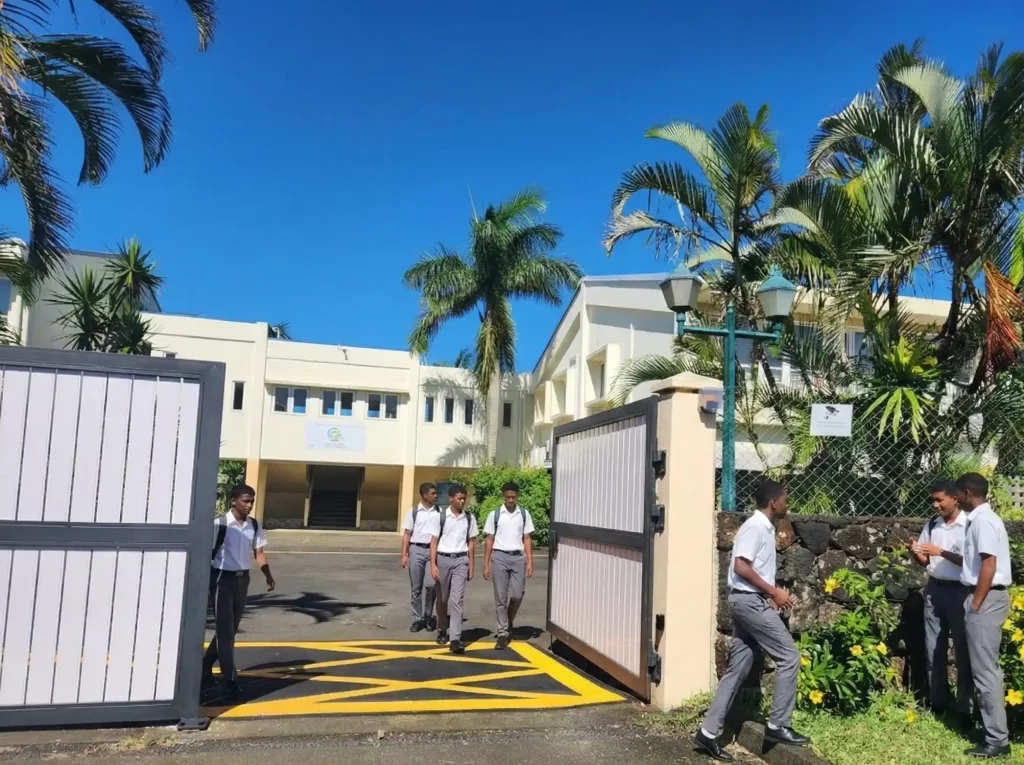
It is an excellent starting point for younger children, offering a gentle introduction to the British curriculum in a friendly, supportive setting.
- The Vibe: Community-focused and friendly.
- Curriculum: British National Curriculum.
- Flexibility: They offer monthly payment options which is a rare blessing for cash flow.
Themis International School (Cascavelle)
Themis operates from nursery through secondary levels and has introduced a unique financial model to the island. Located in Cascavelle, it is accessible for families across the west. What makes Themis interesting is its “membership” structure. You can buy into Silver, Gold, or Platinum tiers, which grant you cumulative discounts on tuition.
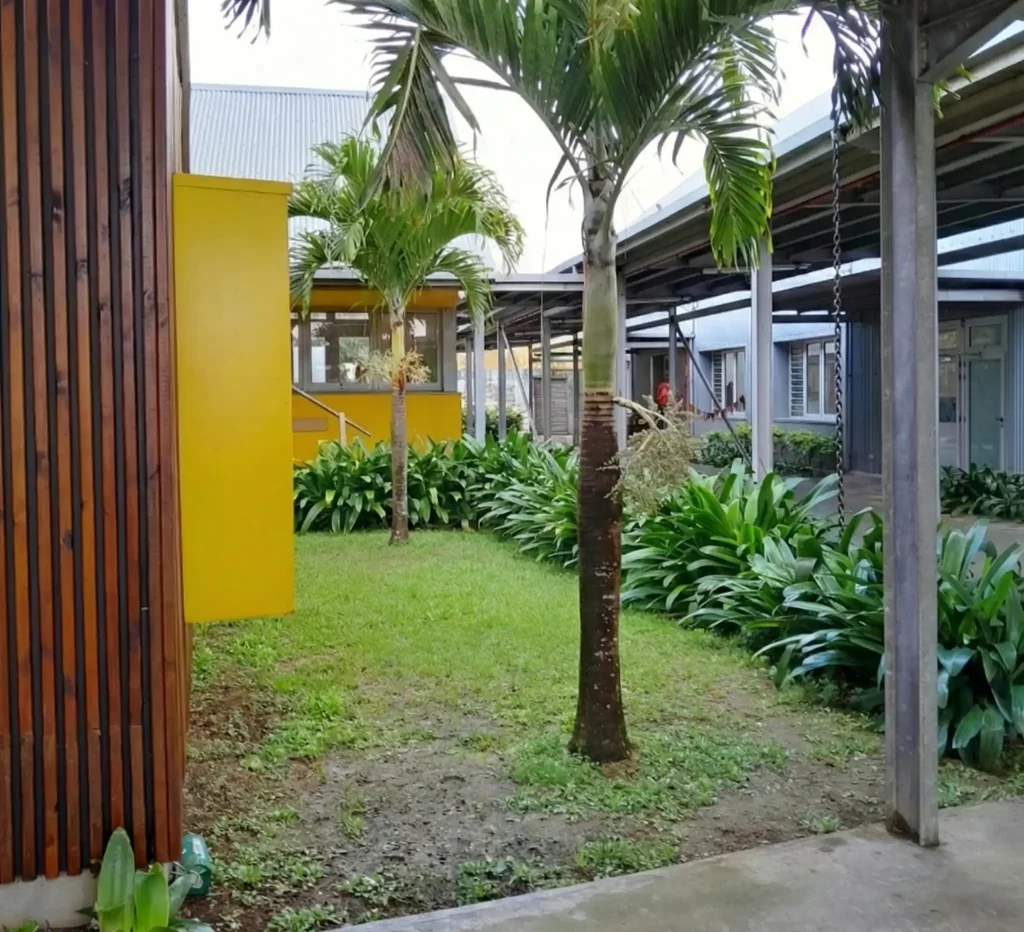
For a family with three kids planning to stay on the island for five years, this can result in massive savings, making it a strategic financial choice as well as an educational one.
- The Model: Membership tiers provide discounts of 5-15% depending on how much you pay upfront.
- Cost: Base tuition is around MUR 252,000 annually for primary.
The South: The Quiet Achiever
Savannah International School (Gros Bois)
If you are living in the wild south, you used to be stuck driving miles for a good school. Not anymore. Savannah International serves the pre-reception through Year 6 crowd in the Gros Bois residential estate. It is perfect for families who want to escape the hustle of the north and center for a quieter, greener life.
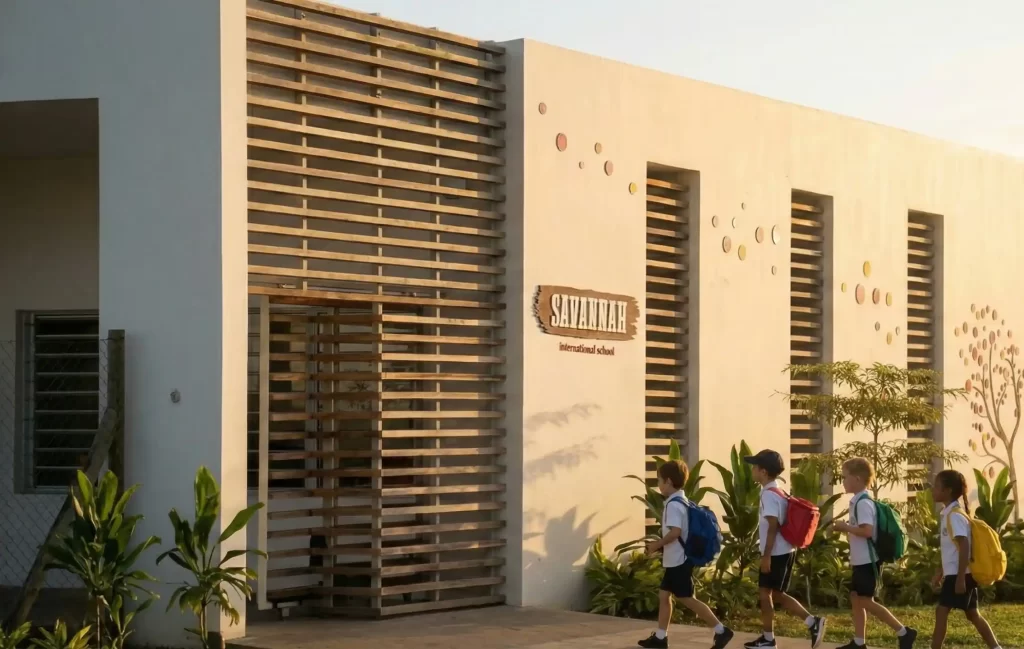
The school offers a solid British curriculum and has priced itself competitively, acknowledging that the commute to other regions is a major barrier for southern residents.
- The Vibe: Peaceful, green, and community-centered.
- Curriculum: British National Curriculum.
- Cost: Very competitive at MUR 216,000 annually for primary.
The Money Talk: Fee Breakdown (2026 Estimates)
Prepare yourself. Education is likely to be your biggest expense after rent. Here is what you need to budget for.
To better understand how these costs fit into your overall budget, check out our Mauritius living cost calculator.
| Fee Component | Typical Amount (MUR) | Notes |
|---|---|---|
| Application Fee | 3,500 – 4,000 | Non-refundable. You pay this just to say “hello”. |
| Enrolment Fee | 50,000 – 65,000 | The “Welcome to the Club” fee. One-off. |
| Refundable Deposit | 3 months tuition | Usually deducted from your final term. |
| Annual Tuition (Primary) | 180,000 – 288,000 | Varies by school and year. |
| Annual Tuition (Secondary) | 300,000 – 460,000 | Gets more expensive as they get older. |
| Meal Fees | 1,400 – 1,800 / month | Mandatory at some schools. |
| Resource Fee | 2,500 – 5,000 | For textbooks, art supplies, and glitter. |
| Uniforms | 2,000 – 3,000 | Initial set up cost. |
Important Money Tips:
- Currency: All fees are in Mauritian Rupees (MUR). As of 2026, 1 USD is roughly 42-45 MUR.
- Discounts: Always ask for the sibling discount. It is usually 5-15% for the second child. If you pay the full year in advance, you can often get an 8% discount.
- Deposits: Be careful here. You usually need to give one full term’s notice (3 months) to get your deposit back. If you leave suddenly, that money is fini (finished/gone).
British Curriculum vs. IB: The Showdown
You will hear parents arguing about this at dinner parties.
British National Curriculum (Northfields Primary, Savannah, Telfair) This is structured. It is predictable. You do your GCSEs at 16 and A-Levels at 18.
- Pros: Great if you plan to move back to the UK or want deep specialization in a few subjects (A-Levels).
- Cons: Can be a bit rigid for some free spirits.
International Baccalaureate (IB) (Le Bocage, Northfields, West Coast) The IB is the holistic, inquiry-based option.
- Pros: Creates well-rounded critical thinkers. Universities love the IB Diploma.
- Cons: The Diploma Programme (last two years) is notoriously difficult. It is a heavy workload with 6 subjects plus Theory of Knowledge and an Extended Essay.
The Admission Process: Jump Through The Hoops
Getting into these schools is not just about showing up with a checkbook.
- Apply Early: I mean it. 6 to 12 months in advance. The “Big 3” have waiting lists that are longer than the queue for dholl puri at lunchtime.
- The Paperwork: You will need:
- Passport copies
- Birth certificates
- Previous school reports (last 2-3 years)
- Vaccination records
- Bank statements (to prove you are not broke)
- The Assessment: Secondary students often have to take an entrance exam.
- The Visa: Once you have a conditional offer and pay the deposit, the school will help you with the student visa. Do not delay this. Immigration takes time.
Practical Survival Tips for Expats
The School Run I cannot stress this enough. Traffic in Mauritius is real. If you live in Grand Baie and your kid goes to Le Bocage in Moka, you are looking at 45 minutes to an hour each way during peak times. Try to live near the school.
Language Your kids will learn French. Even in English-medium schools, French is taught daily. Within a year, your zenfan (children) will be correcting your pronunciation of “croissant”. Embrace it. It is a huge advantage.
Cultural Fit Visit the schools. Walk around. Do the kids look happy? Does the vibe match your family? Some schools are very academic and competitive. Others are more relaxed. Read the reviews, talk to other parents, and trust your gut.
Conclusion
Mauritius offers an incredible environment for children to grow up in. Whether you choose the prestige of Northfields, the academic rigor of Le Bocage, or the coastal chill of West Coast, your kids are going to get a world-class education.
Yes, it is mari cher (very expensive), but the experience of growing up on a multicultural island, learning multiple languages, and spending weekends exploring hidden gems in Mauritius is priceless.
So, take a deep breath, pay the deposit, and get ready for the first day of school. You have got this!
External Links: