
If you have ever felt a bit clumsy, a bit round, or like you just don’t quite fit in with the “cool” birds of the animal kingdom, you might find a kindred spirit in the dodo. For centuries, this bird has been the punchline of biological jokes. “Dead as a dodo” is the go to phrase for anything obsolete, implying that this creature was simply too silly to survive.
But let us set the record straight. The Dodo Bird History is not a comedy of errors; it is a tragedy of circumstances, a marvel of evolution, and potentially, the opening chapter of a science fiction movie come to life. This was not a bird that “forgot” how to fly because it was lazy. It was a creature perfectly adapted to a paradise that suddenly changed.
In this extensive guide, we are going to dive deep into the feathers of Mauritius’s most famous former resident. We will explore its origins as a glorified pigeon, the heartbreaking speed of its extinction, and the mind bending science that might actually bring it back by the late 2020s. Yes, you read that right. Jurassic Park might be closer than you think, but with fewer T-Rexes and more feathers.
Contents
The Origins in Dodo Bird History: A Pigeon Pumping Iron
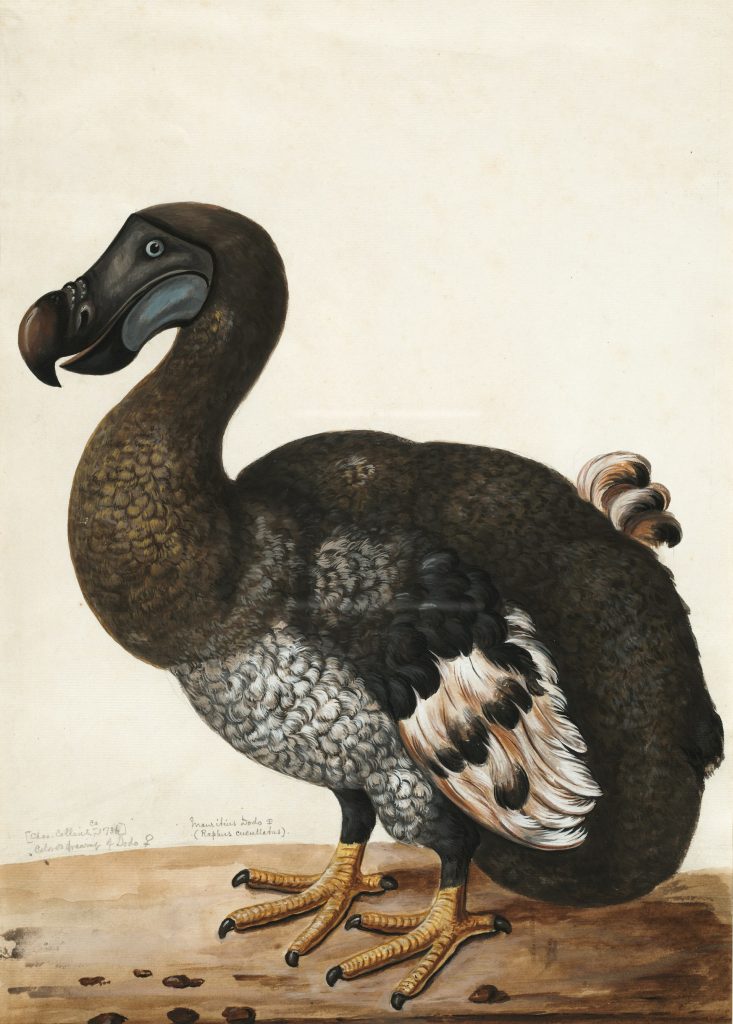
When we talk about Dodo Bird History, we have to start with the family tree. You might look at a dodo—a one meter tall, 20 kilogram bowling ball with a beak—and think it looks like a dinosaur or a very confused turkey. But science has dropped the mic on this one: the dodo was a pigeon.
Specifically, it belonged to the family Columbidae. Its scientific name is Raphus cucullatus. Imagine the pigeons you see in Trafalgar Square or New York City, then imagine one that hit the gym, drank strictly protein shakes, and decided that flying was for birds with lower self esteem.
The Closest Relatives
Genetic evidence has confirmed that the dodo’s closest living relative is the Nicobar pigeon (Caloenas nicobarica). If you place them side by side, you have to squint to see the resemblance, but it is there in the DNA. The Nicobar pigeon lives in Southeast Asia, hangs out on islands, and looks quite glamorous with its iridescent feathers.
The evolutionary split happened roughly 23 million years ago. While the Nicobar pigeon stayed relatively compact and kept its frequent flyer miles, the ancestor of the dodo found its way to Mauritius. Finding no natural predators, it decided to settle down. This is a phenomenon known as “island gigantism.” Essentially, without tigers or wolves trying to eat you, there is no need to be small and agile. You can afford to get big, comfortable, and flightless. It is the evolutionary equivalent of retiring to a villa and wearing elasticated waistbands.
Anatomy and Lifestyle in Dodo Bird History
The dodo was not just a blob. It was a biologically fascinating machine. Understanding its physical form is key to understanding Dodo Bird History.
Built for the Island Life
Standing about 3 feet tall and weighing anywhere between 10 and 21 kilograms, the dodo was a heavyweight. Interestingly, their weight wasn’t constant. Historical records and biological analysis suggest they bulked up during the wet season to survive the dry season. It was a smart survival strategy, not gluttony.
The beak was its most striking feature. Measuring about 23 centimeters, it was hooked and strong. While cartoons depict it as a goofy smile, in reality, that beak was a formidable tool used for cracking open nuts, eating fruit, and arguably delivering a nasty nip if another dodo got too close to its territory.
The Flightless Wonder
Why did it stop flying? Because flying is expensive. It takes massive energy. If your food is on the ground (fallen fruit) and nothing is trying to chase you, wings become useless baggage. Over millions of years, the dodo’s wings shrank to small, vestigial appendages.
Some scientists believe these little wings were used for balance as the bird navigated the rocky, uneven terrain of Mauritius. Contrary to the popular image of dodos stumbling around sandy beaches, they were primarily forest dwellers. They lived in the drier coastal forests of the South and West. If you go on one of the best hikes in Mauritius today, particularly in the Black River Gorges, you are walking through the ghost of their living room.
The Tragic Extinction in Dodo Bird History
This is the part of Dodo Bird History that requires a tissue. The speed of the dodo’s extinction is terrifying. The bird was first recorded by Dutch sailors in 1598. By 1662—less than a century later—the last confirmed sighting occurred. In the grand scheme of geological time, they vanished in a blink.
The Myth of “Stupidity”
Let us debunk a myth. The dodo was not stupid. It just had no context for humans. Having evolved for millions of years without mammalian predators, it had no fear instinct when a Dutch sailor walked up to it. It didn’t run because it didn’t know it was supposed to. This fearlessness was interpreted as stupidity by the sailors, who found them ridiculously easy to catch.
The Three Horsemen of Extinction
While hungry sailors certainly ate their fair share of dodos (though apparently, the meat was tough and not particularly tasty), they weren’t the sole cause of extinction. It was a combination of factors:
- Habitat Destruction: The settlers cleared the forests for wood and agriculture. The dodo’s home was bulldozed.
- Invasive Species: This was the killer blow. The ships brought rats. The settlers brought pigs, cats, and monkeys (macaques). The dodo was a ground nester. It laid a single egg in a nest on the forest floor.
- The “Spawn Kill”: Pigs and monkeys smashed the eggs; rats ate the chicks. The dodo population couldn’t recover. With a reproduction rate of just one egg per season, the invasive species effectively “spawn killed” the entire species.
By the time humans realized the dodo was rare, it was already too late. It became the first species where humanity was forced to admit: “We did this.”
The Dodo as a National Symbol
Today, Dodo Bird History is kept alive in the heart of Mauritian culture. You cannot walk five meters in Port Louis without seeing a dodo. It is on the currency. It is on the coat of arms (holding a sugar cane, looking quite proud). It is on t-shirts, mugs, and carved into wooden souvenirs.
But it is more than just a logo. For Mauritians, the dodo represents a unique natural heritage. It serves as a reminder of the fragility of paradise. It is a symbol of humility and welcome—perhaps a bit too much welcome in the past, but now channeled into the island’s famous hospitality.
If you are exploring the island, perhaps following our 7-day Mauritius itinerary, take a moment to visit the Natural History Museum in Port Louis. There, you can see skeletons and reconstructions that bring the reality of this bird to life. It is a sobering but essential stop.
De-extinction: A New Chapter in Dodo Bird History?
Here is where the story shifts from a history book to a sci-fi novel. As of 2025, Dodo Bird History might be getting a sequel.
Colossal Biosciences, a Texas-based “de-extinction” company (yes, that is a real industry now), is actively working to bring the dodo back. They aren’t just brainstorming; they have raised over half a billion dollars to revive the dodo, the woolly mammoth, and the Tasmanian tiger.
The Science: How Do You Clone a Ghost?
You cannot just clone a bird like you clone a sheep (Dolly style). Birds lay eggs, which makes the nuclear transfer process incredibly difficult. So, Colossal is using a method that sounds like absolute magic.
- The Blueprint: In 2023, scientists sequenced the full genome of the dodo using ancient DNA from a museum specimen that still had some soft tissue. They now have the instruction manual.
- The Cousin: They are using the Nicobar pigeon (the living cousin) as a reference point.
- The Breakthrough of 2025: In September 2025, Colossal announced they successfully cultured “primordial germ cells” (PGCs) from pigeons. These are the cells that turn into sperm and eggs.
- The Surrogate: They plan to edit the DNA of these pigeon cells to match the dodo, then insert them into a sterile chicken embryo.
- The Result: The chicken hatches. It looks like a chicken. But when it grows up and mates, it lays an egg. And out of that egg comes… a dodo (or something very close to it).
Is It Really a Dodo?
This is the philosophical question of Dodo Bird History. The creature Colossal creates will be a hybrid. It will be a Nicobar pigeon genome edited to express dodo traits. It will look like a dodo, walk like a dodo, and probably quack (coo?) like a dodo. But is it the same species?
Scientists call it a “functional copy” or “proxy species.” It will fill the ecological niche of the dodo. It will disperse seeds like a dodo. But it will be a 21st-century invention.
The Ecological and Ethical Debate
Just because we can bring it back, should we? The revival of the dodo raises massive questions for Dodo Bird History.
Where Will It Live?
The Mauritius of 1662 is gone. The forests have changed. The island is populated by 1.2 million people. Invasive species (rats, cats) are still here. Colossal has established the Mauritius Dodo Advisory Committee to figure this out. They are looking at rewilding programs, potentially creating predator-free sanctuaries on offshore islets.
If you are interested in the current state of the island’s nature, check out our guide to the ultimate guide to Mauritius, which highlights the existing conservation efforts for other birds like the Pink Pigeon and the Kestrel.
The Moral Hazard
Some conservationists worry that “de-extinction” is a distraction. Why spend millions bringing back a ghost when we are struggling to save the species that are still here? On the flip side, the technology developed to save the dodo (like the avian genetic editing) could be used to save modern birds from diseases.
A Timeline for Return
When can you expect to see a dodo on your next holiday? Colossal has estimated a timeline of 5-7 years from the start of the project. Given the breakthroughs in 2025, we might realistically see a hatchling by the early 2030s.
Imagine checking the best time to visit Mauritius not just for the weather, but to book tickets for the first public viewing of a living dodo. It sounds insane, but the money and the science are moving fast.
What This Means for Mauritius
The return of the dodo would be a monumental moment for Mauritius. It would reclaim a part of its stolen identity. It would also likely trigger a tourism boom that would require a serious look at the Mauritius living cost calculator 2025 as demand skyrockets.
But even if the science fails, the Dodo Bird History remains a powerful lesson. It teaches us about the vulnerability of isolated ecosystems. It reminds us that our actions have permanent consequences.
The Legacy Lives On
For now, the dodo exists in our imagination, in museums, and in the spirit of the island. It is the mascot of resilience (ironically) and a symbol of conservation.
If you visit Mauritius, pay your respects. Buy a dodo fridge magnet. Hike the forests where they once roamed. And if you see a pigeon looking particularly plump and confident, give it a nod. It might just be carrying the DNA of a legend.
The story of the dodo started with a pigeon getting comfortable on an island. It ended with tragedy. But thanks to human ingenuity (and perhaps a bit of guilt), the final chapter of Dodo Bird History hasn’t been written yet. We are just waiting for the egg to hatch.
External Resources:
Island Biodiversity and Conservation Centre
Colossal Biosciences – The Dodo Project
Oxford University Museum of Natural History
CNN – Dodo De-extinction Breakthrough
Scientific American – The Tech Behind De-extinction
Smithsonian Magazine – Dodo Revival