When you picture Mauritius, you probably see a hammock, a cocktail with a little umbrella, and absolutely zero spreadsheets. It is the ultimate holiday cliché. But unless you have won the lottery or invented a new cryptocurrency that actually works (and if you have, call us), you probably need to work to fund that island lifestyle.
The good news? Working in Mauritius is not just a fantasy. It is a very real career move for thousands of expats. The island is rapidly transforming from a sugar-and-sand economy into a serious business hub for finance, technology, and professional services. It is a place where “work-life balance” isn’t just a corporate buzzword, it is actually possible to leave the office at 5 PM and be snorkeling by 5:30 PM.
But before you pack your laptop and your flip-flops, you need to know the truth. Is it all kas poz (chilled/relaxing) by the pool, or is there real work to be done? We have crunched the numbers, analyzed the market, and are here to give you the lowdown on earning a living in paradise.
Contents
The Economic Landscape: More Than Just Tourism
Mauritius maintains a robust upper-middle-income economy that has successfully transitioned beyond its historical dependence on sugar cultivation. We are now a regional financial hub with serious muscle in technology, manufacturing, and business process outsourcing. With a workforce of approximately 1.2 million professionals, the island is buzzing with activity.
For professionals, this creates what we call “institutional-grade opportunity” with a lifestyle chaser. While your friends back home are commuting two hours in the grey drizzle to pay for a shoebox apartment, you could be driving 20 minutes to a modern office in Ebene Cybercity, knowing your weekend plans involve a catamaran trip.
The workforce is multilingual (English and French), which gives us a competitive edge. Plus, the government is actively rolling out the red carpet for foreign talent through streamlined immigration procedures and targeted incentives.

Get Directions to Ebene Cybercity on Google Maps
Visas and Work Authorization: Your Golden Ticket
You cannot just show up and start working. You need the right paperwork. Thankfully, the Economic Development Board (EDB) has streamlined this process significantly. The National Electronic Licensing System (NELS) keeps things transparent, so you aren’t left guessing. Here is the detailed menu of options:
1. ProPass (Standard Professional Permit)
This is the entry-level ticket for most professionals.
- The Rules: To qualify, you generally need a minimum monthly salary.
- For high-demand sectors like Information Technology, Pharmaceuticals, Food Processing, and BPO, the threshold is MUR 30,000 (approx. $697 USD).
- For all other industries, the threshold is MUR 60,000 (approx. $1,395 USD).
- Validity: It lasts for the duration of your employment contract, up to a maximum of 10 years.
- Processing: Usually takes 4-6 weeks. Your employer handles the heavy lifting, so you can relax.
2. Expert Pass
For the big leagues. If you are a senior consultant, technical expert, or executive, this is for you.
- The Rules: You need a monthly salary of MUR 250,000 (approx. $5,813 USD). This category acknowledges that specialized expertise justifies premium compensation.
3. Young Professional Occupation Permit (YPOP)
Did you study at a Mauritian university? Good news! You can stay and work.
- The Rules: Designed to retain talent studied locally. The minimum salary requirement is MUR 25,000 (approx. $581 USD).
- Validity: Valid for 3 years, giving you time to build your career.
4. Self-Employed and Investor Permits
Want to be your own boss?
- Self-Employed: You need to invest USD 35,000 (approx. MUR 1,505,000) initially. You must also show documented client commitments, specifically, three letters of intent, with at least two coming from local clients. Your target? Annual turnover starting at MUR 750,000 (approx. $17,440 USD).
- Investor: Similar logic but for larger operations with higher capital contributions or performance metrics.
5. The Premium Visa (Digital Nomad)
The remote worker’s dream.
- Cost: Free.
- Requirement: Prove remote income of $1,500 USD (approx. MUR 64,500) monthly for individuals, or $3,000 USD (approx. MUR 129,000) for couples (plus $500 per dependent).
- Benefit: Live here for a year (renewable). The kicker? You pay zero tax in Mauritius on your foreign-sourced income. Read more in our digital nomad life in Mauritius guide.

The Money Talk: Salaries by Sector
Here is the part where expectations often clash with reality. If you are coming from London or New York, the raw numbers might look different. However, remember the Cost of Living is significantly lower here, about 55% cheaper than the US including rent.
The national average salary is around MUR 46,333 (approx. $1,077 USD), but skilled expats usually earn much more.
1. Information Technology: The Gold Mine
The IT sector is booming, growing significantly faster than the general economy. The government loves tech, and there is a shortage of skills in AI, cybersecurity, and fintech.
- Salary Range: Expats typically see ranges between MUR 29,480 and MUR 101,717 ($685 – $2,365 USD) monthly.
- Specific Roles:
- Lead Developers: Command around MUR 99,892 ($2,323 USD) monthly.
- IT Product Managers: Earn approx. MUR 91,249 ($2,122 USD) monthly.
- IT Architects: Can expect MUR 104,081 ($2,420 USD) monthly.
- IT Directors: Top of the food chain at MUR 125,752 ($2,924 USD) monthly.
- Bonus: These bands often exceed local averages by 100-150%.
2. Financial Services and Banking
Mauritius is an offshore banking giant. The sector demands compliance officers, fund managers, and analysts.
- Financial Managers: Average MUR 100,725 ($2,342 USD) monthly.
- Banking Progression:
- Entry Level (0-2 years): Approx. MUR 18,067 ($420 USD) monthly.
- Mid-Career (5-10 years): Approx. MUR 35,700 ($830 USD) monthly.
- Experienced (20+ years): Approx. MUR 49,733 ($1,156 USD) monthly.
- Education Matters: A Master’s degree holder can earn 30% more than someone with just a certificate.
3. Business Process Outsourcing (BPO)
Capitalizing on our time zone (GMT+4), BPO is huge.
- Call Center Directors: Can earn MUR 117,598 ($2,734 USD) monthly.
- The sector offers pathways from entry-level customer service to senior operations management.
4. Teaching and Education
International schools pay well because they need international experience and credentials.
- International School Teachers: Ranges from MUR 50,000 to MUR 90,000 ($1,162 – $2,093 USD) monthly.
- Perks: Packages often include housing allowances, transport, and massive fee reductions for your own kids.
- University Level: Professors average MUR 49,000 ($1,140 USD) monthly, varying by institution.
5. Manufacturing and Healthcare
- Manufacturing: Supervisors earn MUR 25,000 – 40,000 ($581 – $930 USD) monthly, while Technical Managers can exceed MUR 80,000 ($1,860 USD).
- Pharma Sales: Reps earn between MUR 33,387 and MUR 77,045 ($776 – $1,791 USD) monthly.
Detailed Salary Breakdown Table
To make it easier to digest, here is a snapshot of monthly earning potential across various high-demand roles.
| Position | Monthly Salary (MUR) | Monthly Salary (USD approx.) |
|---|---|---|
| IT Director | 125,752 | $2,924 |
| Call Center Director | 117,598 | $2,734 |
| IT Architect | 104,081 | $2,420 |
| Financial Manager | 100,725 | $2,342 |
| Lead Developer | 99,892 | $2,323 |
| IT Product Manager | 91,249 | $2,122 |
| Intl. School Teacher | 50,000 – 90,000 | $1,162 – $2,093 |
| Pharma Sales Rep | 33,387 – 77,045 | $776 – $1,791 |
| Mid-Career Banker | 35,700 | $830 |
Note: USD conversions are approximate based on MUR 43 = 1 USD.

Employment Costs: The Hidden Numbers
It is not just about what you take home; it is about what it costs to hire you. If you are an employer or negotiating a package, you should know about the statutory contributions. These add about 8.5% to the cost of employment.
- CSG (Corporate Social Group) Basic: 3% of gross salary.
- CSG Standard: 1.5% of gross salary.
- NSF (National Savings Fund): 2.5% of gross salary.
- NSF Levy: 1.5% of gross salary.
While these acronyms sound boring, they ensure you are part of the social safety net.
Work Culture and Leave: The “Lagniappe”
This is where the island shines. We don’t believe in working until you drop. The Workers’ Rights Act 2019 ensures you have a life outside the office.
Working Hours The standard work week is 45 hours, usually 9 hours a day for 5 days.
- Breaks: You get a mandatory 45-minute meal break for every 6 hours worked.
- Overtime: Weekday overtime is paid at 1.5x the normal rate. Public holiday work? That is 2x (double time).
- Rest: You are guaranteed 11 hours of consecutive rest between shifts and 24 hours of rest weekly (usually Sunday).
Generous Leave Provisions
- Vacation: 20 working days + 2 additional days = 22 days annually (after 1 year of service).
- Sick Leave: 15 days fully paid (can accumulate up to 90 days).
- Maternity: 12-14 weeks fully paid (6 weeks before, 6-8 weeks after). Plus a MUR 3,000 ($70 USD) maternity allowance.
- Paternity: 5 days paid.
- Special Leave: 6 days for your first marriage (yes, specifically the first one!), and 3 days for a child’s marriage or bereavement.
The 13th Month This is mandatory. You get a bonus equivalent to one month’s salary at the end of the year. It feels like a high-five from your bank account.
Work-Life Balance Flexibility is growing. Many companies, especially in IT and Finance, embrace remote work. The culture encourages separation between work and life. You finish work, you go to the beach. It is that simple. Culturally, we have lagniappe, giving a little extra. Relationships matter. Say “Ki manier?” (How are you?) to your colleagues. It breaks the ice instantly.
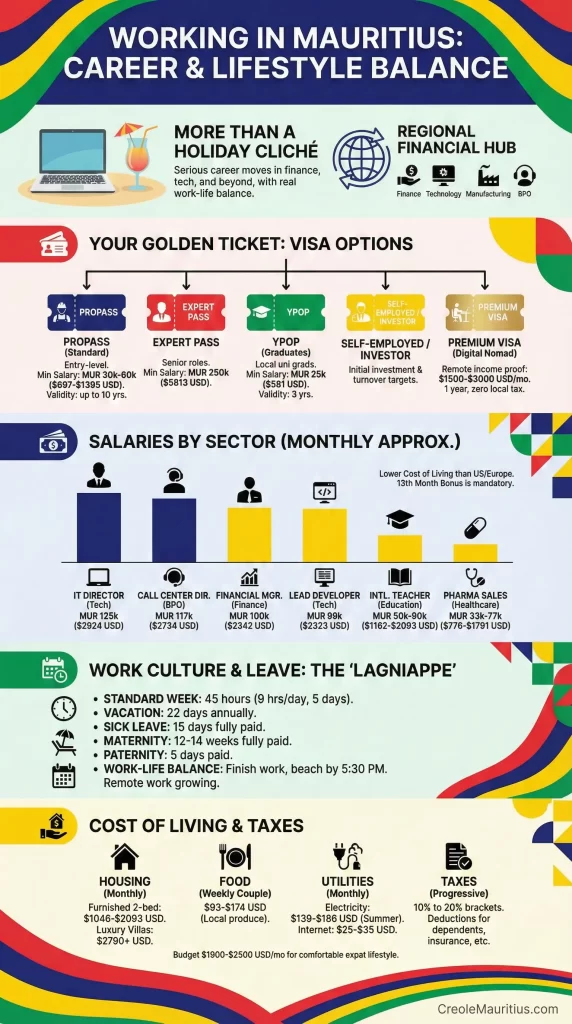
Cost of Living: Living Large for Less
This is where the math really works in your favor. You can live a very comfortable life here for much less than in Europe or the US. Budgeting for a comfortable expat lifestyle usually lands between $1,900 and $2,500 USD monthly.
Housing Accommodation is your biggest cost, but you get a lot for your money.
- Grand Baie / Tamarin: Furnished 2-bedroom apartments range from MUR 45,000 to 90,000 ($1,046 – $2,093 USD).
- Luxury Living: Spacious family villas with pools in gated estates go for MUR 120,000+ ($2,790+ USD).
- Port Louis: City apartments are cheaper, around MUR 15,000 – 20,000 ($348 – $465 USD).
- Note: Home insurance is affordable, around MUR 15,000 – 30,000 ($348 – $697 USD) annually for a 4-bedroom house.
Food and Groceries If you eat like a local, it is cheap. If you insist on imported French cheese every day, it gets pricey (30-50% premium).
- Weekly Shop (Couple): MUR 4,000 – 7,500 ($93 – $174 USD) focusing on local produce.
- Staples: Rice is MUR 1.19/kg, Chicken breast is MUR 5.61/kg (prices vary by market).
- Dining Out: Street food is under MUR 250 ($5.80 USD). A nice mid-range dinner is MUR 1,000 – 1,500 ($23 – $35 USD).
Utilities
- Electricity: Averages MUR 6,000 – 8,000 ($139 – $186 USD) in summer (AC is life). Drops to MUR 5,000 ($116 USD) in winter.
- Internet: Fiber ranges from MUR 1,100 to 1,500 ($25 – $35 USD).
- Water: Very cheap, usually MUR 500 – 1,000 ($11 – $23 USD) monthly.
Healthcare Planning Public healthcare is free, but most expats opt for private insurance for speed and comfort.
- Private Insurance: Basic hospitalization starts at MUR 34,800 ($809 USD) annually. Comprehensive plans covering outpatient care range from MUR 64,500 to 129,000 ($1,500 – $3,000 USD) per year.
To calculate your specific budget, check our Mauritius living cost calculator.
Taxes: Keeping More of What You Earn
Our taxman is relatively friendly. The system is progressive, and there are deductions that can help.
Tax Brackets:
- Up to MUR 325,000 ($7,558 USD): 10%
- MUR 325,001 – 650,000 ($7,558 – $15,116 USD): 15%
- Over MUR 650,000 ($15,116 USD): 20%
- Note: High earners may face a 15% “Fair Share Contribution” surcharge.
Deductions: You can reduce your taxable income by deducting expenses for:
- Dependent children (especially if studying abroad).
- Medical insurance premiums.
- Household employees (cleaners, gardeners).
- Solar energy investments.
- Interest on housing loans.
Employers handle the PAYE (Pay As You Earn), so you don’t have to do much math. Just fill out your Employee Declaration Form (EDF).
Challenges: The “Real Talk”
We promised you an honest guide. Successful expatriate transitions require a bit of effort.
- Salary Differential: Sometimes, expats get paid 20-50% more than locals for the same job due to “expatriate allowances.” This can create tension. Be humble and aware of this sensitivity.
- Social Circles: While Mauritians are super friendly and tolerant (diverse religious holidays are celebrated by everyone!), breaking into tight-knit social circles takes time. Learning a bit of Creole helps immensely.
- Property Taxes: If you plan to buy, note that transfer taxes for non-citizens on approved schemes recently went up to 10%. Renting might be smarter initially.
- Competition: The job market is competitive. Specialized skills get you hired; generalists struggle. Credentials (ACCA, CPA, CAMS) matter.
The Verdict
For strategic professionals, especially in IT and Finance, working in Mauritius offers a golden ticket. It is a chance to build a serious career without sacrificing your mental health.
You trade the rat race for a swim race in the lagoon. You trade the grey sky for blue. And even if the salary number on the contract looks a little smaller in USD terms compared to New York, the purchasing power and the life you build with it feel a whole lot bigger.
So, update that CV, practice your “Ki manier?”, and get ready. The office view is waiting for you.
External Links: